Tuesday, February 16, 2016

The Rich Keep Getting Richer and The Poor Are Getting Poorer

Inequality, class and life expectancy in America

15 February 2016
A study by Brookings Institution economists released Friday documents a sharp increase in life span divergences between the rich and the poor in America. The report, based on an analysis of Census Bureau and Social Security Administration data, concludes that for men born in 1950, the gap in life expectancy between the top 10 percent of wage earners and the bottom 10 percent is more than double the gap for their counterparts born in 1920.
 (DISCLAIMER: I neither agree nor disagree with the social or political philosophy expressed in this article. It is presented merely to disclose the underlying factual basis of the arguments put forth. The Facts and the Statistics speak for themselves.)
For those born in 1920, there was a six-year differential between rich and poor. For those born in 1950, that difference had reached 14 years. For women, the gap grew from 4.7 years to 13 years, almost tripling.
Overall, life expectancy for the bottom 10 percent improved by just 3 percent for men born in 1950 over those born in 1920. For the top 10 percent, it soared by about 28 percent.
Life expectancy for the bottom 10 percent of male wage earners born in 1950 rose by less than one year compared to that for male workers born 40 years earlier—to 73.6 from 72.9. But for the top 10 percent, life expectancy leapt to 87.2 from 79.1.
The United States ranks among the worst so-called rich countries when it comes to life expectancy. But its low ranking is entirely due to the poor health and high mortality of low-income Americans. According to the Social Security Administration, life expectancy for the wealthiest US men at age 60 was just below the rates for Iceland and Japan, two countries with the highest levels. Americans in the bottom quarter of the wage scale, on the other hand, ranked just above Poland and the Czech Republic.
Life-expectancy is the most basic indicator of social well-being. The minimal increase for low-income workers and the widening disparity between the poor and the rich is a stark commentary on the immense growth of social inequality and class polarization in the United States. It underscores the fact that socioeconomic class is the fundamental category of social life under capitalism—one that conditions every aspect of life, including its length.
The Brookings Institution findings shed further light on the catastrophic decline in the social position of the American working class. They follow recent reports showing a sharp rise in death rates for both young and middle-aged white workers, primarily due to drug abuse, alcoholism and suicide. Other recent reports have shown a dramatic decline in life expectancy for poorer middle-aged Americans and a reversal of decades of declining infant mortality.
It is no mystery what is behind this vast social retrogression. It is the product of the decay of American capitalism and a four-decade-long offensive by the ruling elite against the working class. From Reagan to the Obama administration, Democrats and Republicans alike have overseen a corporate-government assault on the jobs, wages, pensions and health benefits of working people.
The ruling elite has dismantled the bulk of the country’s industrial infrastructure, destroying decent-paying jobs by the millions, and turned to the most parasitic and criminal forms of financial speculation as the main source of its profit and private wealth. Untold trillions have been squandered to finance perpetual war and the maniacal self-enrichment of the top 1 percent and 0.1 percent.
The basic infrastructure of the country has been starved of funds and left to rot, to the point where uncounted millions of people are being poisoned with lead and other toxins from corroded water systems. Flint, Michigan is just the tip of the iceberg.
Under Obama, this social counterrevolution has been intensified. The financial meltdown of 2008 has been utilized by the same forces that precipitated the crash to carry through a reordering of social relations aimed at reversing every social gain won by the working class in the course of a century of struggle. A central target of the attack is health care for working people.
Obamacare is the spearhead of a worked-out strategy to reduce the quantity and quality of health care available to workers and reorganize the health care system directly on a class basis. Corporate and government costs are to be slashed by gutting employer-paid health care, forcing workers individually to buy expensive, bare-bones plans from the insurance monopolies, and rationing drugs, tests and medical procedures to make them inaccessible to workers.
The rise in mortality for workers and the widening of the life span gap between rich and poor are not simply the outcome of impersonal economic forces. In corporate boardrooms, think tanks and state agencies, the ruling class is working to lower working class life expectancy. In late 2013, the Center for Strategic and International Studies, a Washington think tank with the closest ties to the Pentagon and the CIA, published two policy papers decrying the “waste” of money on health care for the elderly. The clear message was that ordinary people were living much too long and diverting resources needed by the military to wage war around the world.
The social and economic chasm in America finds a political expression in the vast disconnect between the entire political establishment and the masses of working people. Neither party nor any of their presidential candidates, the self-described “socialist” Bernie Sanders included, can seriously address the real state of social conditions or offer a serious program to address the crisis.
In his final State of the Union Address last month, Obama presented an absurd picture of a resurgent economy. “The United States of America, right now,” he declared, “has the strongest, most durable economy in the world… Anyone claiming that America’s economy is in decline is peddling fiction.”
In the race for the Democratic presidential nomination, Hillary Clinton and Sanders are seeking to outdo one another in seizing the mantle of the Obama administration and praising its supposed social and economic achievements.
They cannot address the real conditions facing the masses of working people because they defend the capitalist system, which is the source of the social disaster. The remedy must be based on an understanding of the disease. It is the building of an independent socialist and revolutionary movement uniting the entire working class, in the US and around the world.
(Barry Grey, World Socialist Web Site)
(DISCLAIMER: I neither agree nor disagree with the social or political philosophy expressed in this article. It is presented merely to disclose the underlying factual basis of the arguments put forth. The Facts and the Statistics speak for themselves.)

You Have To Pay Taxes On Your Social Security Retirement Benefits

Tax On Social Security May Come As Surprise


The requirement to pay income tax on Social Security Retirement benefits may come as a surprise to many retirees. Baby boomers beware. It is a fact.
Many Americans don't realize that the Social Security benefits they receive in retirement can be subject to income tax. But millions of Americans will find out in the years to come, because the percentage of Social Security benefits that they'll end up returning to Uncle Sam in the form of income taxes will rise dramatically, according to a study from the Social Security Administration.
How much will income taxes on Social Security rise?
In the past, most of those who paid income taxes on their Social Security benefits are among the top half of income earners. The quarter of the American population that had the highest income paid about 14% of their benefits to the government in 2010 in the form of income taxes. That compared to just 5% for those in the second-highest 25% of the population, and the bottom half of the income distribution paid 0.5% or less of their benefits in income tax.
But the SSA sees that percentage rising dramatically, and most of the additional burden will be on the middle class. By 2025, the percentage of benefits that upper-middle class Americans pay in taxes on their benefits will have doubled to almost 10%, and families in the second-lowest 25% of the income distribution will have seen their tax liability rise sixfold to 3%.

The main reason why people will pay more of their Social Security benefits in income taxes has to do with the formula the IRS uses. In order to figure out how much of your benefits you have to include in taxable income, you have to total up all of your taxable income, and then add in half of your Social Security benefits. If that figure is more than $25,000 for single filers or $32,000 for joint filers, then up to half of your benefits can get taxed. If it's above $34,000 for singles or $44,000 for joint filers, the maximum percentage of your benefits included in taxable income rises to 85%.
Most IRS formulas are indexed for inflation, but the one that calculates Social Security taxation isn't. Therefore, as inflation pulls wages up, more people will pass the dollar thresholds listed above. Unless lawmakers add an inflation index provision, a law that initially affected only high-income taxpayers will slowly but surely affect all Americans.


For an individual, 50 percent of Social Security benefits are subject to income tax if the individual’s income is more than $25,000 a year and 85 percent of benefits are subject to tax if the income is more than $34,000 a year, according to the Social Security Administration.
For a couple, the respective income levels are $32,000 and $44,000. Income for these purposes includes adjusted gross income, tax-exempt interest income and half of the Social Security benefits.
 Social Security is a primary source of retirement income for tens of millions of Americans, and financial planners urge people to take maximum advantage of the Social Security benefits they've earned. For many planners, that means advising their clients to wait beyond the early claiming age of 62 before taking their benefits. But even though waiting can be smart for some people, there are good reasons for others to go ahead and take benefits as soon as possible.
These are desperate times for many people in America who were once considered among the Middle Class. They have seen their living standards decline and are struggling to make ends meet. Many were laid off in the last eight years and have not been able to find new jobs. They are not counted in the Unemployment Statistics because they have dropped out of the labor pool. Many are between the ages of 50 and 65 and do not yet qualify for Social Security Retirement Benefits. They have not even reached the age when they would be eligible to apply for early retirement. For many Baby Boomers that is around age 62.
Social Security pays out smaller monthly benefits to those who claim early, but the extra payments give early claimers a head start over those who wait. The Social Security Administration's goal initially was to set things up so that timing didn't have a material impact on how much you would receive in benefits over your lifetime.
If you don't expect you'll live as long as the typical Social Security recipient, then claiming early can make sense. Keep in mind, though, that if you have a spouse or other loved ones who will claim benefits based on your work record, your decision can affect their benefits as well. But if you don't have family members who will claim survivor benefits, then you'll end up better off claiming early if you expect not to reach the age that the SSA's life expectancy projections would predict.

The primary reason to wait to take Social Security benefits is one based on mathematics and maximizing your family's total benefits. For some, however, getting the biggest check possible isn't as valuable as living the life they want.
For many, taking Social Security early allows them to retire at an earlier age or cut back on their hours. Others prefer to use the additional cash early in their retirement when they can still enjoy it the most. Financial planners would tell you that you're leaving money on the table in many cases, but the actual value of those additional dollars might not be as much as getting to pick the time when the money will have the greatest impact.
People who die earlier should start drawing their Social Security Retirement Benefits earlier. Life-expectancy is the most basic indicator of social well-being. The minimal increase for low-income workers and the widening disparity between the poor and the rich is a stark commentary on the immense growth of social inequality and class polarization in the United States. It underscores the fact that socioeconomic class is the fundamental category of social life under capitalism—one that conditions every aspect of life, including its length.
The Brookings Institution findings shed further light on the catastrophic decline in the social position of the American working class. They follow recent reports showing a sharp rise in death rates for both young and middle-aged white workers, primarily due to drug abuse, alcoholism and suicide. Other recent reports have shown a dramatic decline in life expectancy for poorer middle-aged Americans and a reversal of decades of declining infant mortality.
Late last year, lawmakers made changes to benefits available to Social Security participants who waited until full retirement age to claim benefits. Among them were the repeal of the restricted application or file-as-a-spouse-first strategy and the file-and-suspend strategy. Under a restricted application, those who reached full retirement age could elect to claim only spousal benefits, leaving their own retirement benefits untouched. Similarly, using file and suspend, someone at full retirement age or older could file for benefits but immediately suspend them and still allow a spouse to claim spousal benefits.
As a result of these legal changes, there's no longer as much incentive for married couples to wait until full retirement age -- currently age 66 -- to claim their benefits. The thousands of dollars that these couples will no longer be eligible to receive could be enough to push the balance toward claiming earlier rather than waiting, especially if some of the other factors above would ordinarily lead them to take benefits at 62.
When to claim Social Security is a tough decision that involves plenty of variables. But even though many financial planners urge their clients to think twice before claiming benefits at the earliest possible age, there are situations where it makes more sense to go ahead and take Social Security at 62 rather than waiting.
Financial advisors need to know this and be prepared to warn clients about the issue. Tax planning affects when a person should take Social Security Retirement benefits and when benefits should be delayed and that money instead taken from an investment portfolio.
In most situations, a retiree is better off delaying receiving Social Security benefits until he or she is 70 years old because benefits grow by about 8 percent a year until the recipient reaches 70.
In addition, with the current high market value, taking withdrawals from a portfolio now will not deplete the portfolio as much as they would if the market makes a correction. When a retiree hits 70.5 years of age, a minimum distribution amount is required to be taken from an IRA or 401(k). If some money has already been withdrawn before the person reaches 70.5, the required minimum distribution will be less and the tax burden decreased accordingly.
Each client’s situation is different. The tax implications must be determined for each retiree. But advisors may want to help their clients build an income bridge so Social Security Retirement benefits can be delayed until they reach their maximum.

Oldest Boomers Face Big Birthday


The oldest Baby Boomers are facing a big birthday this year as they turn 70, which brings with it some forced financial decisions.
The oldest boomers will have to start taking required minimum distributions (RMDs) from their qualified retirement accounts and those who have delayed receiving their Social Security benefits will start receiving that money.
Ideally, the oldest baby boomers began talking with their financial advisors and planning for retirement a decade ago, says Bill Van Sant, senior vice president at Girard Partners Ltd., a Univest Wealth Management company in King of Prussia, Pa.
“This is an important birthday. Those turning 70.5 years old can take their RMD the next year but we advise them to take it the year they turn 70.5 or they will have to take two in the following year, which could push them into a higher tax bracket for that one year,” Van Sant says.
The RMD for retirement plans is determined by a formula based on the value of the assets in the plan. In most cases, the money was not taxed when it was contributed, so it is taxed as it is taken out.
If an annual withdrawal is missed, the penalty is a stiff one, says Mike Piershale, president of Piershale Financial Group in Crystal Lake, Ill. Piershale had a client who was unaware of the required withdrawal, which in her case turned out to be $16,000 for the first year.
“She would have been penalized $8,000 or 50 percent because no one had told her she was required to take money out of her tax qualified plan. We managed to get the money back for her by explaining to the IRS that it was a mistake on her part that first year,” Piershale says.
Withdrawals are required from traditional IRAs and also from company 401(k) plans, if the person is no longer working for the company.
“We make sure we remind our clients of the required withdrawals before they turn 70,” says Piershale.
Ellen Jordan, senior vice president at Bryn Mawr Trust, a wealth management firm in Bryn Mawr, Pa., notes that baby boomers are the first generation that has saved in tax deferred accounts because companies phased out pensions.
“Now they have to start spending what they accumulated and the big scare is that they will not have enough money for the rest of their lives,” Jordan says. “Depending on their health, they may want to continue working.”
Jordan says Bryn Mawr sometimes advises clients to start taking distributions from tax-deferred accounts gradually before they turn 70.5 so they are not pushed into a higher tax bracket when they begin required withdrawals.
Advisors also need to remind clients that Social Security benefits can be taxed. For an individual, 50 percent of Social Security benefit is subject to federal income tax if the income is above $25,000 and 85 percent is taxed if the income exceeds $34,000, according to the Social Security Administration. The limits for couples are $32,000 and $44,000, respectively.
This year presents another deadline as well, advisors are reminding their clients. The Social Security Administration is phasing out the strategy known as file and suspend. Under this strategy, one spouse is able to file and suspend his benefits to allow the other person to collect spousal benefits. This allows the first spouse’s benefits to grow until age 70.
The SSA has given couples until the end of April to file for this benefit, after which it will no longer be available.
(In part Based on Articles By Karen DeMasters)

Friday, January 29, 2016

Loose Lips Sink Ships and Kill Spies, The Real Hillary Clinton


 Discussions with Intelligence Community officials have revealed that Ms. Clinton’s “unclassified” emails included Holy Grail items of American espionage such as the true names of Central Intelligence Agency intelligence officers serving overseas under cover. Worse, some of those exposed are serving under non-official cover. NOCs (see this for an explanation of their important role in espionage) are the pointy end of the CIA spear and they are always at risk of exposure – which is what Ms. Clinton’s emails have done.

For the younger voters, low information voters, and brain washed voters.... here is a bit of Hillary Clinton I am betting you don't remember...

Many people who may vote in the democratic primary election and the general election in 2016 have no real knowledge of Mrs. Clinton or her accomplishments. As a public service, I thought I would provide some input regarding her triumphs for consideration.

When Bill Clinton was president, he allowed Hillary to assume authority over a health care reform. Even after threats and intimidation, she couldn’t even get a vote in a democratic controlled congress. This fiasco cost the American taxpayers about $13 million in cost for studies, promotion, and other efforts.

Then President Clinton gave Hillary authority over selecting a female attorney general. Her first two selections were Zoe Baird and Kimba Wood – both were forced to withdraw their names from consideration. Next she chose Janet Reno – husband Bill described her selection as “my worst mistake.” Some may not remember that Reno made the decision to gas and burn alive David Koresh and the Branch Davidian religious sect in Waco, Texas resulting in dozens of deaths of women and children.

Husband Bill allowed Hillary to make recommendations for the head of the Civil Rights Commission. Lani Guanier was her selection. When a little probing led to the discovered of Ms. Guanier’s radical views, her name had to be withdrawn from consideration.

Apparently a slow learner, husband Bill allowed Hillary to make some more recommendations. She chose former law partners Web Hubbel for the Justice Department, Vince Foster for the White House staff, and William Kennedy for the Treasury Department. Her selections went well: Hubbel went to prison, Foster (presumably) committed suicide, and Kennedy was forced to resign.


Many younger voters will have no knowledge of “Travelgate.” Hillary wanted to award unfettered travel contracts to Clinton friend Harry Thompson – and the White House Travel Office refused to comply. She managed to have them reported to the FBI and fired. This ruined their reputations, cost them their jobs, and caused a thirty-six month investigation. Only one employee, Billy Dale was charged with a crime, and that of the enormous crime of mixing personal and White House funds. A jury acquitted him of any crime in less than two hours.


Still not convinced of her ineptness, Hillary was allowed to recommend a close Clinton friend, Craig Livingstone, for the position of Director of White House security. When Livingstone was investigated for the improper access of about 900 FBI files of Clinton enemies (Filegate) and the widespread use of drugs by White House staff, suddenly Hillary and the president denied even knowing Livingstone, and of course, denied knowledge of drug use in the White House. Following this debacle, the FBI closed its White House Liaison Office after more than thirty years of service to seven presidents.

 
Next, when women started coming forward with allegations of sexual harassment and rape by Bill Clinton, Hillary was put in charge of the “bimbo eruption” and scandal defense. Some of her more notable decisions in the debacle were:
· She urged her husband not to settle the Paula Jones lawsuit. After the Starr investigation they settled with Ms. Jones.
· She refused to release the Whitewater documents, which led to the appointment of Ken Starr as Special Prosecutor. After $80 million dollars of taxpayer money was spent, Starr’s investigation led to Monica Lewinsky, which led to Bill lying about and later admitting his affairs.


· Hillary’s devious game plan resulted in Bill losing his license to practice law for lying under oath to a grand jury and then his subsequent impeachment by the House of Representatives.
· Hillary avoided indictment for perjury and obstruction of justice during the Starr investigation by repeating, “I do not recall,” “I have no recollection,” and “I don’t know” a total of 56 times while under oath.


· After leaving the White House, Hillary was forced to return an estimated $200,000 in White House furniture, china, and artwork that she had stolen.

 
Now we are exposed to: the destruction of possibly incriminating emails while Hillary was Secretary of State and the “pay to play” schemes of the Clinton Foundation – we have no idea what shoe will fall next. 

The FBI has been able to retrieve another 22 emails from Hillary's private server. Those emails are too sensitive to release. They are classified even higher than Top Secret. "These emails are shocking. They show the Obama State Department’s plan to set up non-government computers and a computer network for Hillary Clinton to bypass the State Department network,” said Tom Fitton.

That these records were withheld from the American people until now is scandalous and shows the criminal probe of Hillary Clinton’s email system should include current and former officials of the Obama administration.

The reason that the latest 22 Clinton emails are too secretive to release, even with redactions, is that they contain the REAL NAMES of covert CIA agents in the field, and worse, non-official cover agents. 

Those individuals and foreign entities who have hacked her private email system have in their possession information that can get these agents captured, turned or killed. People HAVE gone to prison for exposing this type of information' Meanwhile, Hillary and her mouthpieces, are calling this new round of discovery a "Nothing Burger".

"Today FoxNews has reported that those twenty-two Top Secret emails included “operational intelligence” that involves espionage sources and methods, adding that lives have been put at risk by Hillary’s mishandling of this information.

I can confirm that the FoxNews report, which lacks any specifics about exactly what was compromised, is accurate. And what was actually in those Top Secret emails found on Hillary’s “unclassified” personal bathroom server was colossally damaging to our national security and has put lives at risk.

Discussions with Intelligence Community officials have revealed that Ms. Clinton’s “unclassified” emails included Holy Grail items of American espionage such as the true names of Central Intelligence Agency intelligence officers serving overseas under cover. Worse, some of those exposed are serving under non-official cover. NOCs (see this for an explanation of their important role in espionage) are the pointy end of the CIA spear and they are always at risk of exposure – which is what Ms. Clinton’s emails have done.

Not only have these spies had their lives put in serious risk by this, it’s a clear violation of Federal law. The Intelligence Identities Protection Act of 1982, enacted due to the murder of the CIA’s station chief in Athens after his cover was blown by the left-wing media, makes it a Federal crime to divulge the true identity of any covert operative serving U.S. intelligence if that person has not previous been publicly acknowledged to be working for our spy agencies."


But to her loyal fans" – “what difference does it make?” -
 
She killed vets and Ambassadors: She has Blood on Her Hands: wake up people!
 
Please share the truth..

(By Mickey Ebert Sants, The Daily Ledger, Facebook Comment Post, Jan 29, 2016) 

Wednesday, January 27, 2016

Honorably Discharged Navy Veteran Defrauded VA and SSA Of $1.5 Million


‘Wheelchair-Bound’ Man Caught in Disability Fraud After Seen Jet Skiing, Riding Motorcycle. He conned the VA and the SSA out of millions of dollars.

/ AP
/ AP

A South Carolina man was convicted of “one of the largest” disability fraud cases in Veterans Affairs history after he was caught riding a motorcycle and going jet skiing while pretending to be wheelchair-bound.
Dennis Paulsen faces up to 20 years in prison for conning the VA and Social Security Administration (SSA) out of millions of dollars, taking nearly $10,000 a month for more than a decade.
Mr. Paulsen obtained the benefits by pretending he was unable to use his feet or hands due to a multiple sclerosis diagnosis (MS). Meanwhile, he regularly hit the gym, joined a club baseball team, played golf, and drove around in his Escalade.
“In conducting one of the largest fraudulent single disability compensation claims in VA history, Paulsen substantially feigned and exaggerated the impairment resulting from his multiple sclerosis (MS) diagnosis,” the Social Security Administration’s(SSA) Inspector General(IG) said. “After being diagnosed and discharged from the Navy in the early 1990s, Paulsen began receiving a monthly VA benefit as a result of his diagnosis. Unsatisfied with the amount he was receiving, Paulsen began a pattern of malingering by claiming his MS rendered him unable to use his hands or feet in any respect.”
“Still unhappy with the money he was awarded, Paulsen ramped up his claims, lying to his doctors, presenting himself as house- and wheelchair-bound, and making false claims that he required daily professional medical care to live until his benefits were increased to the maximum disability payments available to a Veteran,” the inspector general said.
In all, Paulsen was able to steal $1.5 million from the government, collecting $9,400 each month.
The case is reminiscent of the case of a “blind” Wisconsin man whose Social Security disability fraud scheme ended when federal agents caught him driving a speedboat. Paulsen was caught driving a motorcycle.
“Despite his feigned claims of impairments and presenting himself in a wheelchair to his doctors, Paulsen lived in a non-handicap-accessible residence and was able to ride his motorcycle and jet skis plus play baseball and golf on a regular basis,” the inspector general said. “In 1999, Paulsen met his ex-wife at the gym where he exercised and worked training others.”
Paulsen was also “active in several gyms, joined a baseball league from 2006 until 2014,” and seen “playing pool, swimming in his backyard pool, playing on the beach, and driving his Escalade and manual shift Mini Cooper.” He even participated in a Marine Mud Run.
Investigators used surveillance footage and family photographs to reveal Paulsen’s very active lifestyle, contradicting his claim of suffering from a severe disability.
Paulsen continues to exaggerate his condition, appearing at his trial in federal court, which concluded last week, in a wheelchair.
“Paulsen testified, in a wheelchair, for four hours and called three doctors as expert witnesses in an attempt to support his claim that he was and had been totally disabled,” the inspector general said. “The guilty verdict reflects that the jury did not find this testimony credible.”

(BY:

(By Elizabeth Harrington) 
Elizabeth Harrington is a staff writer for the Washington Free Beacon. Elizabeth graduated from Temple University in 2010. Prior to joining the Free Beacon, she worked as a staff writer for CNSNews.com. Her email address is elizabeth@freebeacon.com. Her Twitter handle is @LizWFB.

Tuesday, January 26, 2016

SSA Claimant Suicide Easily Predictable

Lawsuit blames two suicides on move to cut disability benefits

Lawsuit blames two suicides on notice of imminent cut in disability benefits.

 A move by the Social Security Administration (SSA) to end disability checks for thousands of people in Kentucky played a substantial role in two people killing themselves, a federal lawsuit alleges.

The two dead claimants committed suicide by gunshot. They blew out their brains. Melissa Jude and Leroy Burchett, were despondent after getting notice that they would lose benefits, the lawsuit alleges.
Burchett shot himself in the chin on June 1. Jude shot herself in the head the next day, according to the lawsuit.
The lawsuit further alleges that two Social Security recipients were distraught over the notice from SSA that they would lose their livelihood and might have to repay pass benefits received.
Social Security has notified thousands of benefit recipients of the impending loss of checks.
This case is linked to allegations of fraud in disability cases of Kentucky lawyer Eric Conn.

Tuesday, January 19, 2016

The Long Wait At SSA

Sick And Waiting For Help In Miami, The Longest Line For Disability In The USA


Consider the Case of Sherice Bennett. She is a caretaker in Florida.
She takes care of her sister who has cerebral palsy. She had two sons, two dogs and she still has the tank that used to house her turtle and fish.
It’s a role she happily fills on top of the other roles she’s taken on over the years: call center coordinator, caterer, accounts payable, executive secretary and, when that failed, school bus and truck driver.
But about 10 years ago, working in any capacity started getting harder. Bennett was diagnosed with diabetes that had gone untreated for a while. A few years later she injured her ankle, which meant she couldn’t stand up for very long. Then an inflammatory lung disease, arthritis in her hands, and in 2013, after putting off visits to the doctor, she was told he had an aortic valve condition, something she was born with.
She had to stop working. She had no health insurance.
Disability benefits were designed to help when people get sick or hurt and can’t work. Those on disability get monthly disbursements to go towards expenses and automatically get health insurance -- either Medicaid or Medicare.
Most disability applications are initially denied. After two denials, the only other recourse is to request a hearing to make your case in front of an Administrative Law Judge (ALJ) at the Social Security Administration (SSA). And in Miami, that can take a long time.
The Social Security Administration is responsible for handling applications for disability benefits.
Over the last year, the Miami Office of Disability Adjudication and Review has had the longest average wait times in the country – a little more than 20 months, that's about two years to get a hearing..
Bennett has applied for disability so many times she’s lost track - at least five times – and each time she’s been denied.
“For me to pay my bills, I have friends sometimes that step up to the plate and they’ll send me money or they’ll pay the bill for me, but you don’t want to be a burden on somebody else,” said Bennett.
“Let's put it this way. If you’re a person and you have means and you have money, you can get up and go to the restaurant. You can take a vacation. You can go out with friends. You can go shopping for clothes. These things that they take for granted are things I have to plan for. I have to put that money away a dollar at a time.”
She filed her most recent application in July of 2014.
So now—like 9000 other people who’ve applied for benefits through the Miami disability office—she’s waiting to argue her case in front of an ALJ and make a convincing argument for why she should not have been denied.
So far, Bennett’s been waiting 18 months on her most recent case. And statistically, she’s got months to go before she’ll get a hearing.
“I had an uncle who was awarded benefits posthumously five years after he applied,” says Thomas Snook, an administrative law judge for the Social Security Administration, where he’s been deciding on disability cases for 18 years.
“There’s something wrong with a system that is designed to help people [who] are disabled, where people are dying before you can hear their cases,” said Snook.
There's something wrong with a system that is designed to help people [who] are disabled, where people are dying before you can hear their cases, said Judge Thomas Snook, ALJ, a Member of the Board of the Association of Administrative Law Judges of America (AALJ) and a judge in the Miami Office of Disability Adjudication and Review(ODAR).
The Social Security Administration  has no plausible  explanation for the long wait.

“It’s my money. I mean, it’s crazy to deny me what I’ve put into the program,” said claimant, Sherice Bennett.
The government takes out money for social security from most paychecks -- money she is hoping to recoup now that she needs it.
“If Social Security had given me what’s due me, I would have Medicare,” said Bennett. “I wouldn’t have to worry about my health, I wouldn't have to worry about how I’m going to pay my bills and just basic living needs.”
In October, Bennett joined a "Class Action Lawsuit" against the Social Security Administration with a dozen other people who’ve been waiting to see a judge -- some of them for nearly 30 months.
The suit was organized by the University of Miami School of Law’s Health Rights Clinic, which sits at this unusual intersection between lawyers and doctors. Through the university, it has easy access to the staff and doctors at the medical school and the clinic is trying to leverage that access to help people get disability benefits more quickly.
Aside from getting things sorted out through the lawsuit, the UM clinic may have figured out another way to deal with the issue on the front end of the problem.
That’s the approach Carlos Nuñez from Stuart, Fla., tried. He has also applied for SSA disability benefits.
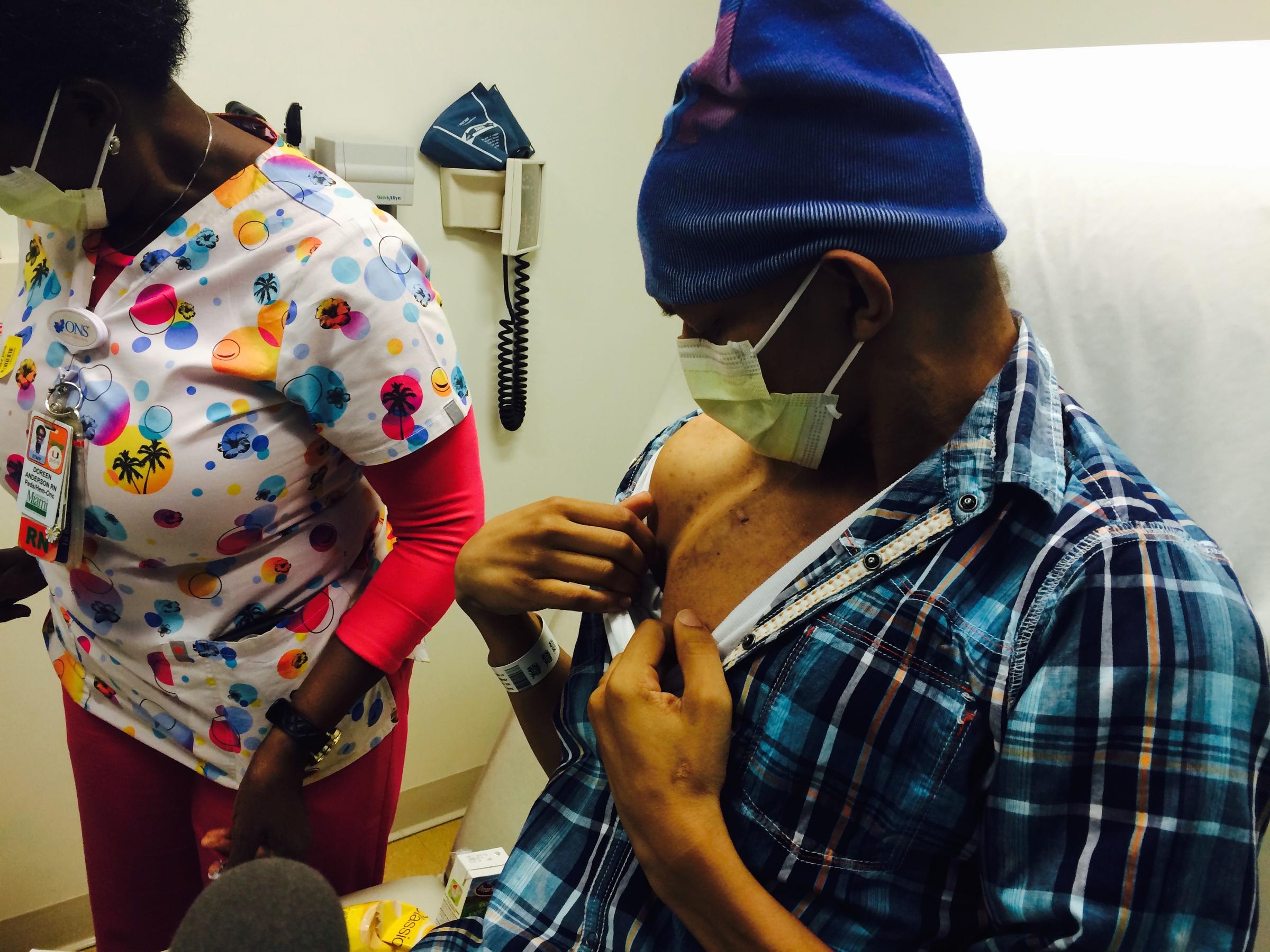
Last April, he was diagnosed with a type of brain cancer usually found in kids. Every few weeks he goes for treatment at the pediatric wing of Sylvester Cancer center in Miami and the treatments can last a few days.
At 23 years old, Nuñez towers over the other patients in the hallways.
He proudly sports a beanie with the face of the cartoon character Stitch on it, a present from his sister. It covers his head — bare except for a little fuzz — but it doesn’t hide the half-foot-long scar long that runs up along the nape of his neck.
Doctors told Nuñez he couldn’t work for at least a year so he quit his job as a cleaner in a mall. His mom had to quit her job, too, in order to drive Nuñez the two hours down to Miami from Stuart almost every week for his treatments. They leave him too weak to drive. Even conversation is hard for him to sustain after a few hours.
Carlos Nuñez would seem like a perfect candidate for a kind of disability called supplemental security income, or SSI.
And with brain surgery, dozens of rounds of chemo and radiation, he says he needs the health insurance he’d get through the program.
He applied right after his brain surgery in April.
“It all goes down to the letter. The letter is the decision,” explains Nuñez. “When I got my letter I was at my house: denial.”
Like Sherice Bennett, the only choice he had was to request a hearing and wait for an ALJ.
But before he submitted that paperwork, he got linked up with the Health Rights Clinic.
Melissa Swain, associate director of the clinic, says Nuñez’s case is so black and white; she has no idea how the Social Security Administration could have denied him in first place. It’s something she sees pretty frequently.
“The problem is that doctors and social security don’t really communicate on the same level. They don’t speak the same language,” explains Swain.
For Dr. Michael Kolber, that difference was very clear in his work at the University of Miami Miller School of Medicine.
“A lot of the disability questions I remember had nothing to do with the way I look at disability,” said Kolber.
And in this litigious world, doctors are wary of filling out forms they’re unfamiliar with. Kolber has helped the Health Rights Clinic bridge some of these divides and get doctors on board with the clinic's seemingly simple solutions.
For Carlos, Swain of the Health Rights Clinic created a one-page solution that translates the medical diagnosis into language made for the Social Security Administration "so that they could understand: 'Oh, wait. He is eligible, what were we thinking?' ”
This one page is essentially a road-map to the hundreds of pages of evidence people like Nuñez have to submit from their doctors -- in language made for the Social Security Administration.
And with this one-page form, the students at the health clinic got his case reopened and approved.
This type of one-page form could cut down the number of people waiting for a disability hearing. And that, hypothetically, could help cut down on the extremely long wait times for other people who don’t have as cut-and-dry cases.
The clinic is hoping to make more of these road-maps available to the public, but Swain knows Nuñez’s case is unusual.

Nuñez won his benefits and automatically gets Medicaid, which helps pay for medical expenses like chemo therapy.
She doesn’t see the Social Security office going back and reopening a bunch of cases like Sherice Bennett’s, who just has to continue waiting for her latest disability hearing.
In the meantime, she’s had open-heart surgery. The hospital picked up the tab.
If she wins her benefits, though, she could get back pay -- all the way back to when she first applied six years ago.
She says if she gets disability benefits, she’d buy a home with the back pay, but she’d keep her car, just get it fixed up a bit.
And for the first time in a long time, she’d have health insurance.
  )

Monday, January 18, 2016

Thousands Afraid To Appear At Social Security Hearings

Attorneys worry 1,000 or more Social Security beneficiaries will lose checks when re-evaluated.


Attorneys representing hundreds of people fighting to keep their Social Security federal disability benefits worry those benefits may disappear for most of them if they do not have a lawyer.
Each year, the Social Security Administration (SSA) orders thousands of  people to attend Re-Evaluation hearings to determine whether they should continue receiving disability checks.
Many of those people are former clients of  Attorney Eric C. Conn.
In 2011 a story appeared in the Wall Street Journal concerning the high rate in which SSA Judges approved Social Security disability cases.
Allegations of fraud came under investigation by a U.S. Senate committee.  Sen. Tom Coburn, R-Okla., was the Chairman of The Senate Committee. The Committee's Report found widespread fraud and a veritable “disability claim factory” allegedly  run by Attorney Eric C. Conn out of his small office in Stanville, Kentucky, a region of the country where 10 to 15 percent of the population  receives disability payments.
The report documents how Attorney Conn allegedly worked together with Social Security Administrative Law Judge David Daugherty (ALJ)  and a team of favored doctors with checkered pasts, including suspended licenses in other states, who rubber stamped approval of disability claims. In most cases, the claims had been prepared in advance with nearly identical language by staffers in Conn’s law office.
The report found that over the past six years, Attorney Conn allegedly paid five doctors almost $2 million to provide favorable disability opinions for his claimants.
In 2010, the last year for which records are available, Judge Daugherty approved 1375 disability cases prepared by Attorney Conn’s office and denied only 4 of them – an approval  rate that other administrative law judges have described as nearly  impossible.
Judge Daugherty, 78 years old, processed more cases than all but three judges in the U.S. He had a wry view of his less-generous peers. “Some of these judges act like it’s their own damn money we’re giving away,” ALJ Daugherty told a fellow Huntington SSA ALJ, Algernon Tinsley, who worked in the same office, Mr. Tinsley recalled.
 The report found, “Judge Daugherty telephoned the Conn law firm each month and identified a list of Mr. Conn’s disability claimants to whom the judge planned to award benefits. Judge Daugherty also indicated, for each listed claimant, whether he needed a “physical” or “mental” opinion from a medical professional indicating the claimant was disabled.”
The report says that when Senate staffers and the Social Security Administration’s Office of the Inspector General began an investigation based on tips from whistle blowers in the Social Security Hearing Office, Attorney Conn and Judge Daugherty began communicating with disposable, pre-paid cell phones. It also alleges they contracted with a local shredding company to destroy 13 tons of documents.
Attorney Conn also allegedly destroyed all the computer hard drives in his office, a la Hillary Clinton at the State Department.
In 2011, the SSA placed Daugherty on administrative leave. He retired shortly after that.
In October 2013 a West Virginia Police Report said Judge Daugherty was found unconscious in his car in a Barboursville, WVa. church parking lot.
The report said the police found a garden hose running from the car’s exhaust into the passenger side of the vehicle.
Judge Daugherty was taken to a hospital and later released.

Conn has not been charged with a crime. He is suspected by congressional investigators of using fraudulent information to win the benefits. Attorney Conn’s legal fate remains in the hands of the Obama Justice Department.

A prevailing concern is that disability recipients who do not hire an attorney to represent them at their re-determination hearings will lose their benefits.
Unrepresented Claimants should not go through one of these complicated re-determination hearings without a lawyer. People appearing before SSA Administrative Law Judges (ALJ) can get a free lawyer on a contingent fee basis. The attorney does not get paid unless the client wins the case.  That amounts to a free lawyer.
Many disability recipients do not hire legal representation for their hearings. They stand a good chance of losing their benefits.
Even some who were represented at Re-Determination Hearings  are still anxious to hear results.
"Not knowing ... that's been the worst thing is not knowing and trying to prepare in case you do lose your benefits," one beneficiary said.
One attorney who specializes in representing Social Security Claimants has said in recent weeks several people have told him they've thought about killing themselves if they lose their benefits.
"The suicide chatter is way up," the Attorney said. "It was especially bad around Christmas. Unfortunately people have got this unfortunate response that suicide is somehow a rational response to losing their benefits", the attorney said.
Family members of two people who killed themselves in 2015 are suing the Social Security Administration, because they believe that the Social Security Administration’s decision to terminate disability benefit checks was the reason they committed suicide. The families of of John Daniel Jude and Emma Burchett are convinced that the termination of their SSA benefits played a substantial role in their deaths.
Attorneys for John Daniel Jude and Emma Burchett filed a lawsuit in U.S. District Court in Pikeville, KY.
The lawsuit alleges Burchett’s husband, Leroy Burchett, and Jude’s wife, Melissa Jude, killed themselves in June after getting notice that their benefits would be suspended.
More than 1,000 former clients of attorney Eric Conn received the same letter after Attorney Conn was accused of colluding with  Social Security Administrative Law Judge David Daugherty to rig Social Security cases.
These are desperate times for many people in America who were once considered among the Middle Class. They have seen their living standards decline and are struggling to make ends meet. Many were laid off in the last eight years and have not been able to find new jobs. They are not counted in the Unemployment Statistics because they have dropped out of the labor pool. Many are between the ages of 50 and 65 and do not yet qualify for Social Security Retirement Benefits. They have not even reached the age when they would be eligible to apply for early retirement. For many Baby Boomers that is around age 62.