Monday, August 6, 2018

Trump's Executive Order Concerning ALJs; Will It Eliminate The Back Log, Drain The Swamp, of Just Make ALJs Political?

ALJs Could Get Political With New Executive Order


The new executive order (EO) granting agency chiefs the power to hire administrative law judges (ALJs) according to their own standards—and eliminating the exam and competitive hiring process formerly in place—could turn the position of ALJ into a politicized one, critics of the move argue.
The “Executive Order Excepting Administrative Law Judges from the Competitive Service,” signed by President Donald Trump on July 10, attempts to solve the problems raised by the Supreme Court’s decision this year in Lucia v. Securities & Exchange Commission. But critics worry about the unforeseen consequences to the regulatory process that this EO may cause.
What happened
In a closely watched case, the Supreme Court in Lucia held that the common practice of having ALJs appointed by the staffs of federal agencies was unconstitutional. ALJs, such as those used by the Securities and Exchange Commission (SEC), are “Officers of the United States” who can be appointed only by the president, “Courts of Law” or “Heads of Departments” pursuant to the Appointments Clause of the Constitution, the Court held.
The opinion, authored by Justice Elena Kagan and joined by the five conservative-leaning justices (with a concurrence in part by Justice Breyer), has resulted in considerable uncertainty, not just for the SEC but for all federal agencies that use ALJs. ALJs are found throughout the federal system, from the National Labor Relations Board to the Federal Energy Regulatory Commission, with the bulk of the approximately 1,900 ALJs found in the Social Security Administration. Before the president’s July 10 EO, federal agencies had hired ALJs through a competitive merit selection process administered by the Office of Personnel Management. After Lucia, this practice might no longer pass constitutional scrutiny.
In an effort “to eliminate doubt regarding the constitutionality of the method of appointing officials who discharge such significant duties and exercise such significant discretion,” Trump issued the EO.
In the EO, the president explained: “I find that conditions of good administration make necessary an exception to the competitive hiring rules and examinations for the position of ALJ.
“These conditions include the need to provide agency heads with additional flexibility to assess prospective appointees without the limitations imposed by competitive examination and competitive selection procedures.”
The EO “will also give agencies greater ability and discretion to assess critical qualities in ALJ candidates, such as work ethic, judgment, and ability to meet the particular needs of the agency,” the president added. “These are all qualities individuals should have before wielding the significant authority conferred on ALJs, and each agency should be able to assess them without proceeding through complicated and elaborate examination processes or rating procedures that do not necessarily reflect the agency’s particular needs. This change will also promote confidence in, and the durability of, agency adjudications.”
Now, the sole requirement to be appointed an ALJ is a professional license to practice law and good standing to practice in one of the states, the District of Columbia, Puerto Rico or any territorial court. As a result, agency heads have broad discretion to appoint ALJs as they see fit, with very little oversight.
Critics of the EO expressed concern that this new process will lead to political appointments that lack the appearance of independence. “This change will politicize our courts, lead to cronyism and replace independent and impartial adjudicators with those who do the bidding of political appointees,” Marilyn Zahm, president of the Association of Administrative Law Judges, said in a statement, calling the EO “an assault on due process for the American people.”

Why it matters
While the White House touted the EO as a means to alleviate uncertainty in the wake of the Lucia decision and as a more efficient and less burdensome procedure than the former competitive examination and selection process, critics were not appeased. Forgoing the merit-based hiring process and putting the selection power into the hands of politically appointed agency heads will lead to politicized ALJs, opponents argued. Going forward, it will be important to watch and see how this new appointments process affects ALJ decisions throughout the federal agencies.

Monday, June 11, 2018

Fugitive Lawyer Eric Conn Pleads Guilty

Fugitive lawyer pleads guilty for escape, fraud

Attorney Eric Christopher Conn, 58, of Pikeville pleaded guilty before U.S. District Judge Danny C. Reeves of the Eastern District of Kentucky to one count of conspiracy to defraud the United States, one count of conspiracy to escape and one count of conspiracy to retaliate against an informant. Sentencing is set for September 7, 2018.
http://cgacriticalthinkers.blogspot.com/2017/12/when-judge-breaks-law-when-judge-goes.html
According to the plea, from October 2004 to December 2017, Conn participated in a scheme with former SSA administrative law judge David Black Daugherty, multiple doctors, including clinical psychologist Alfred Bradley Adkins, and others to submit thousands of falsified medical documents to the SSA to fraudulently obtain disability benefits totaling more than $550 million for thousands of individuals.
According to the plea, of a former SSA employee discovering and providing information about the scheme to federal agents, Conn and former SSA administrative law judge Charlie Paul Andrus conspired and acted to have the former SSA employee terminated in an effort to discredit the employee.
Finally, Conn admitted that after pleading guilty in March 2017, and prior to being sentenced on June 2, 2017, he fled the country with the help of Curtis Lee Wyatt by severing the electronic monitoring device from his ankle and fleeing across the Mexican border. 
Conn was originally charged in April 2016, along with Daugherty and Adkins, in an 18-count indictment with conspiracy to commit mail and wire fraud and other related offenses in connection with the disability fraud scheme.
Conn subsequently pleaded guilty on March 24, 2017, to a two-count information charging him with theft of government money and paying illegal gratuities, and he was sentenced in absentia on July 14, 2017 to 12 years in prison on those charges.
After his flight from the United States, Conn was charged, along with Wyatt, in September 2017, in a seven-count indictment with conspiracy to escape, escape and other related offenses.
On Dec. 5, 2017, Conn was returned to the United States from Honduras after being apprehended by Honduran authorities.
Conn’s plea today resolves the outstanding charges against him.
In addition to the 12 years in prison Conn is currently serving, he now faces an additional 15 years in prison. As part of the plea agreement, Conn agreed to recommend to the Court at sentencing that the Court sentence him to the maximum possible sentence, a 15-year sentence, and run that sentence consecutive to the 12-year sentence previously imposed, for a total of 27 years in prison.
Andrus pleaded guilty in June 2016 to a one-count information charging him with conspiracy to retaliate against an informant, and was sentenced Aug. 7, 2017 to six months in prison.
Daugherty pleaded guilty in May 2017 to a two-count information charging him with receiving illegal gratuities, and was sentenced on Aug. 25, 2017, to four years in prison.
Adkins was found guilty following a six-day trial in June 2017 of one count of conspiracy to commit mail fraud and wire fraud, one count of mail fraud, one count of wire fraud and one count of making false statements, and was sentenced on Sept. 22, 2017, to 25 years in prison. Wyatt pleaded guilty in March 2018, and is scheduled to be sentenced on June 29.
(June 6, 2018)

Saturday, April 14, 2018

Another NY Cop, Fireman, Bouncer, Muscleman Arrested For Stealing Social Security Disability Benefits


Scott Maraio, 53, was arrested and charged with theft of government funds, making false statements in connection with Social Security disability benefits.
In 2002, at age 37 Maraio claimed he could no longer work as a firefighter, suffering neck and back injuries. He stopped working for the FDNY, began receiving Social Security disability payments.
"I cannot stand or walk for more than a few minutes at a time. I cannot lift or carry more than five pounds," Maraio said in a 2002.
But from 2008 to 2018, he collected more than $364,000 in SS benefits while simultaneously earning over $450,000 as a bouncer, fire safety manager and fireguard.
A Staten Island man who was a cop and firefighter was caught side-gigging as a bouncer at a strip club and television actor while collecting hundreds of thousands on disability, authorities allege.
Scott Maraio, 53, was arrested Wednesday and charged with theft of government funds, making false statements and making false statements in connection with Social Security disability benefits, prosecutors said.
In 2002, a then 37-year-old Maraio claimed he could no longer work as a firefighter after suffering neck and back injuries while on the job. He stopped working for the FDNY, and then began receiving Social Security disability payments, said the complaint filed in Manhattan federal court.
"I cannot stand or walk for more than a few minutes at a time. I cannot lift or carry more than five pounds," Maraio said in a 2002 disability report, according to the court filing.
But from October 2008 to February 2018, the feds allege the defendant collected more than $364,000 in benefits for himself, his wife and children while simultaneously earning approximately $450,000 as a bouncer, fire safety manager and fireguard.
Maraio, who was a police officer for one year, allegedly did not report the extra income and arranged for the payments to be made to third-party companies, including one owned by his wife called Blondie Consultants.
He did report making about $2,000 working as an extra on television shows from 2007 to 2009, said the complaint.
While a security guard at the strip club from 2008 to 2014, he was in good shape, often on his feet and worked 8 p.m. to 4 a.m. shifts, the filing said. His duties included crowd control and checking patrons' identification.
The complaint claims the ex-cop made $110,000 as a security guard at the strip club, and earned around $11,000 in tips from "Beaver Bucks" -- the club's internal form of currency -- he redeemed for cash.
Beginning in 2012, he was working as an independent fire-related contactor at various constriction sites, including Madison Square Garden and Build it Back after Hurricane Sandy, said the complaint. His duties were to prevent fire issues and serving as a fireguard at various events.
Then, last February, Maraio was allegedly caught working full-time as a safety and loss control consultant at a department store construction site in Brooklyn.
Maraio, who public records indicate lives in Great Kills, faces a maximum of 20 years in prison.
Two other defendants, former NYPD detective Kenneth Rubero and ex-officer Gerard Scparta, were charged in separate disability fraud schemes.
From about 1997 up to 2017, Scparta received approximately $638,000 in disability benefits for himself, his wife, and his children, during which time he earned approximately $1.6 million from his work at a strip club, the feds allege.
From about 2008 up to this February, Rubero received a total of approximately $396,000 in disability benefits for himself and his child, during which time Rubero had earned a total of over approximately $720,000 from his work with Baychester and Secure Logistics, authorities said.
"As alleged, these three defendants, all former law enforcement officers, told lie after lie to obtain a total of over one million dollars in disability benefits through fraud," said Manhattan U.S. Attorney Geoffrey S. Berman. "In doing so, they allegedly took money from truly disabled individuals who are dependent on this important source of public support.  Scparta and Maraio also allegedly concealed their employment and income from the Social Security Administration by hiding behind corporate entities purportedly owned by their wives."

Tuesday, April 10, 2018

People Are Dying To Get A Hearing

Short staffing leads to long waits for Social Security disability hearing decisions


The Social Security Administration’s main campus is seen in Woodlawn, Md. (Patrick Semansky/AP)

Robert Steers of Southington, Conn., was an Army captain who served in Afghanistan. He also served his country looking for contraband with the Transportation Security Administration (TSA).
Now, he’d like to get decent service from the Social Security Administration (SSA), but he won't.
As many Americans know, this can be an exasperating experience, filled with endless waits and growing frustration.
Infuriating encounters have earned federal disability programs a spot on the Government Accountability Office’s “high-risk” list, and Steers’s fight with Social Security shows why. Congress is increasingly concerned.
PTSD and worsening depression left Steers, 54, unable to work. He was medically retired from the Army and received an “individual unemployability” determination from the Department of Veterans Affairs. VA considered him at high risk for suicide, according to his attorney.
With this history, getting Social Security Disability Insurance (SSDI) seems like a no-brainer. But Steers applied in April 2012 and was denied. To appeal, he requested a hearing with an administrative law judge (ALJ) in May 2013. It took almost two years to be denied again in March 2015. After appealing to federal court, his case was sent back to the administrative law judge in December 2016.
It is now April 2018 — six years after his initial application — and Steers is still waiting to find out if he’ll get the insurance. Even an inquiry from Sen. Richard Blumenthal (D-Conn.), who claimed to be a VietNam combat veteran, but lied, three years ago hasn’t sped the pace.
“Reducing the Back Log, wait times for a hearing decision is of utmost importance to the Social Security Administration…” said Mark Hinkle, an agency spokesperson. “For several years in a row, the agency received a record number of hearing requests, due primarily to the aging of the baby boomers as they entered their disability-prone years. We also received an increase in applications during the economic recession and its aftermath. During this time, our resources to address disability claims did not keep pace with the increase in applications and backlogs grew. Primarily for these reasons, wait times for a hearing and the number of pending hearings began to rise.”
The current number of pending hearings is about 986,000 and the average wait for a hearing decision is about three years, 600 days. That’s after 15 consecutive months of reducing the number of people waiting for a hearing decision.
“I think SSA does not have the staff it needs,” said Iván A. Ramos, Steers’s lawyer in Hartford, Conn. “When you call a hearing office, nobody answers the phone, and when you go to the office you just stand in front of an empty window until someone finally shows up to help you. Many of my clients have trouble paying for food and shelter while they wait for their disability claims to be processed. Seeing what many of my clients and their families have to go through, just to get a hearing, has become the hardest part of my job.”
Staffing and service issues have plagued Social Security for years, and President Trump’s proposed budget for fiscal 2019 would make things worse. The disability hearing process can be particularly vexing because there are too few administrative law judges, who hear appeals, and they have too few support staff members.
“I am concerned that the increasing strain on the adjudicatory process frustrates the mission of the Social Security Administration (SSA),” Sen. James Lankford (R-Okla.), chairman of the Senate Homeland Security and Governmental Affairs federal management subcommittee, wrote in a March 19 letter to the agency. “Administrative Law Judges (ALJs) perform an essential judiciary function in the United States and as a direct result of the current caseload, claimants may be forced to wait up to two years for a decision on their claim.
“This is not an acceptable constraint on due process.”
Not acceptable, but also not unusual.
 (Above, Left, Marilyn Zahm, an administrative law judge in Buffalo and president of the Association of Administrative Law Judges (AALJ).
“In 2016, the Social Security Administration received over 2.3 million disability claims, 630,000 more cases than in 2002. Unfortunately, the SSA has not added the personnel, technology or efficiencies needed to address this steady surge,” said Marilyn Zahm, an administrative law judge in Buffalo and president of the Association of Administrative Law Judges (AALJ). “We now face a crushing backlog of cases, adding long wait times and painful uncertainty to a process that should be swift and secure.”
Zahm said 2.6 hours “is the average amount of time that a judge is allotted to adjudicate a case,” based on 500 dispositions annually, “the quota mandated by the agency.”
That little time “is not fair to the claimant, the government or the judge,” she added. “Mandating unreasonable quotas leads to inaccurate decision-making in many instances.”
SSA planned to hire 250 ALJs annually from fiscal 2016 through fiscal 2018, which ends Sept. 30. This rate of hiring was needed “to reduce average appeals wait times for hearing decisions to its goal of 270 days by the end of fiscal year 2020,” the GAO report said. Two hundred seventy days is almost 10 months.
 http://cgacriticalthinkers.blogspot.com/2018/03/will-ssa-ever-get-operating-funds-or.html
Social Security hired 264 in 2016, but just 132 in 2017. “As we just received our FY 2018 appropriation, we are currently evaluating our ALJ hiring plan for this year,” Hinkle said.
In September, a report by SSA’s Office of Inspector General found falling levels of hearing office staff, including those who write ALJ decisions, and drooping ALJ productivity. From fiscal 2011 through April 2017, ratios of hearing office staff to ALJs dropped 22 percent, the same decrease in administrative law judge productivity.
“Two main factors related to decreasing ALJ productivity,” the inspector general found, “include decreased staffing ratios and a renewed focus on quality.”
Deciding a case involves “reading the claimant’s record (which may consist of more than 1,000 pages of medical documents), holding a full and fair hearing (listening to the claimant’s testimony and that of expert witnesses), drafting complete instructions according to agency policy, and editing and signing the draft decision,” Zahm said by email.
“We need more staff support and an efficient adjudicatory system,” she added, “rather than management that threatens and browbeats judges to issue more decisions.”
3 Apr 2018.

Thursday, March 29, 2018

Will SSA Ever Get The Operating Funds or a Commissioner?

Social Security Gets Funds to Cut Disability Backlog

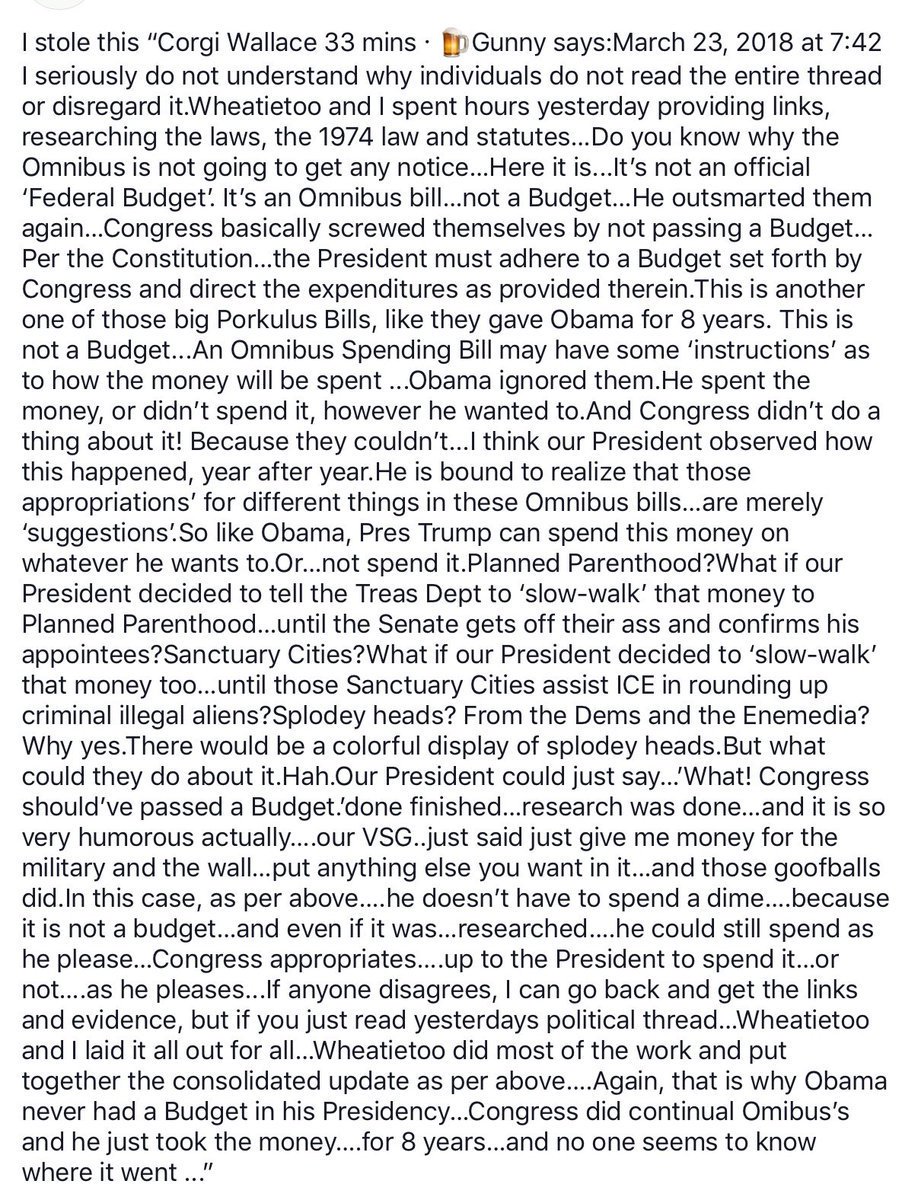
Buried in the recent Omnibus Spending Bill that kept the U.S. government operating is $100 million for the Social Security Administration that is meant, in part, to fix one of the country’s worst but least-understood embarrassments – a multi-year backlog of people waiting to hear if they can get disability benefits.
But an Omnibus Spending Bill is not a Budget Bill. The differences may be crucial.
Omnibus Spending Bill is not a "Budget". Trump can spend the funds any way he wants. Hope this was his plan.

The Social Security Disability Insurance program is supposed to provide a safety net for people unable to work due to injury or illness. According to the latest SSA statistics, nearly 1 million people remain stuck in a hearing-decision backlog that averages 599 days (20 months). In some cities and states, wait times are up to 772 days.
Most of the people in line have already paid for the benefits through their payroll taxes. Yet they remain frustrated by the backlog. The new funds offer the promise that things will finally improve. Maybe the SSA can even beat its own projection that the backlog can’t be significantly reduced for another four years. But it will have to step up its game to make full use of the money.
In September 2017 testimony before the House Ways and Means Committee, Bea Disman, acting chief of staff at the SSA, said the agency was implementing several measures to address the massive backlog. But by the end of 2017, almost no progress had been made on reducing the wait times for applicants, making it the worst in the U.S. government.
This is not just unseemly; it’s tragic. In 2017 alone, more than 10,000 people died waiting to hear if they would be awarded insurance benefits that they had worked for years to earn – a 15 percent increase over the previous year.   
There are several factors that have taken the backlog to a crisis level. First, the SSA has been without a Senate-confirmed leader since 2013, which has limited its ability to tackle this and other challenges. President Obama refused to appoint a Commissioner, and neither has President Trump.
 In addition, the agency has failed to meet its own hiring goal for administrative law judges and support staff who conduct the review hearings, even though it told Congress extra hiring would be a primary tool for reducing the backlog. In fact, only 600 ALJs have been hired over the past three years and only 132 in fiscal year 2017. There is not enough staff to meet the demand.
The SSA requires that applicants provide duplicative medical records of various sorts and then states that it’s overwhelmed by the volume of them.
SSA abolished The Treating Physician Rule
 Due to SSA concerns about subjectivity and physician bias, the agency also no longer assigns greater weight to the opinions of doctors who treat applicants when assessing an individual’s condition and his or her ability to work. Instead it can choose to rely more on the opinion of its own, more cursory, processes to examine the patients or review medical evidence.
 The SSA also doesn’t really take into consideration disability determinations by the U.S. Department of Veterans Affairs, state agencies or private insurers. These entities have disability criteria that are different from the SSA, but their programs are similar enough. These determinations can and should inform SSA decisions and help the SSA avoid a “start from zero” process.
The new funding is welcome and recognizes there’s a problem. But recent data from the SSA indicate the agency is anticipating a dramatic rise in disability applications in 2018 and 2019. So, this story is far from over. Social Security disability benefits remain a complicated mess with no one at the helm to provide strategic leadership to the staff or to the judges who must assess the claims of former workers and their families.
Jim Allsup is chairman and CEO of Allsup LLC, a national disability representation organization and Social Security-authorized Employment Network based in Belleville, Ill.
 COMMENTARY

Sunday, March 25, 2018

Benefit, Welfare, Entitlement, Annuity, or Retirement, Just What Is Social Security?

shared Liz DeVolder's post.
Liz DeVolder
EVERY ONE SHOULD HAVE THE OPPORTUNITY TO READ THIS.
THE ONLY THING WRONG WITH THE
GOVERNMENT'S CALCULATION OF AVAILABLE SOCIAL SECURITY IS THEY FORGOT TO FIGURE IN THE PEOPLE WHO DIED BEFORE THEY EVER COLLECTED A SOCIAL SECURITY CHECK!!!
WHERE DID THAT MONEY GO?
Remember, not only did you and I contribute to Social Security but your employer did, too. It totaled 15% of your income before taxes.
If you averaged only $30K over your working life, that's close to$220,500.
Read that again.
Did you see where the Government paid in one single penny?
We are talking about the money you and your employer put in a Government bank to ensure you and me that we would have a retirement check from the money we put in, not the Government.
Now they are calling the money we put in an entitlement when we reach the age to take it back.
If you calculate the future invested value of $4,500 per year (yours & your employer's contribution) at a simple 5% interest (less than what the Government pays on the money that it borrows).
After 49 years of working you'd have$892,919.98.
If you took out only 3% per year, you'd receive $26,787.60 per year and it would last better than 30 years (until you're 95 if you retire at age 65) and that's with no interest paid on that final amount on deposit!
If you bought an annuity and it paid 4% per year, you'd have a lifetime income of $2,976.40 per month.
THE FOLKS IN WASHINGTON HAVE PULLED OFF A BIGGER PONZI SCHEME THAN BERNIE MADOFF EVER DID.
Entitlement my foot; I paid cash for my social security insurance!
Just because they borrowed the money for another government spending, doesn't make my benefits some kind of charity or handout!!
Remember the benefits for members of Congress?
+ free healthcare,
+ outrageous retirement packages,
+ 67 paid holidays,
+ three weeks paid vacation,
+ unlimited paid sick days.
Now that's welfare, and they have the nerve to call my social security retirement payments entitlements?
They call Social Security and Medicare an entitlement even though most of us have been paying for it all our working lives, and now, when it's time for us to collect, the government is running out of money.
Why did the government borrow from it in the first place? It was supposed to be in a locked box, not part of the general fund.
Sad isn't it?

Wednesday, January 24, 2018

If You Cannot Trust The Clerk At The Social Security Office To Help With Your Case, Who Can You Trust?

Feds say Social Security rep scammed thousands from clients. Then he shot a selfie.


Read more here: http://www.charlotteobserver.com/news/local/crime/article196260704.html#storylink=cpy