Showing posts with label Checks and Balances.. Show all posts

Tuesday, August 13, 2013

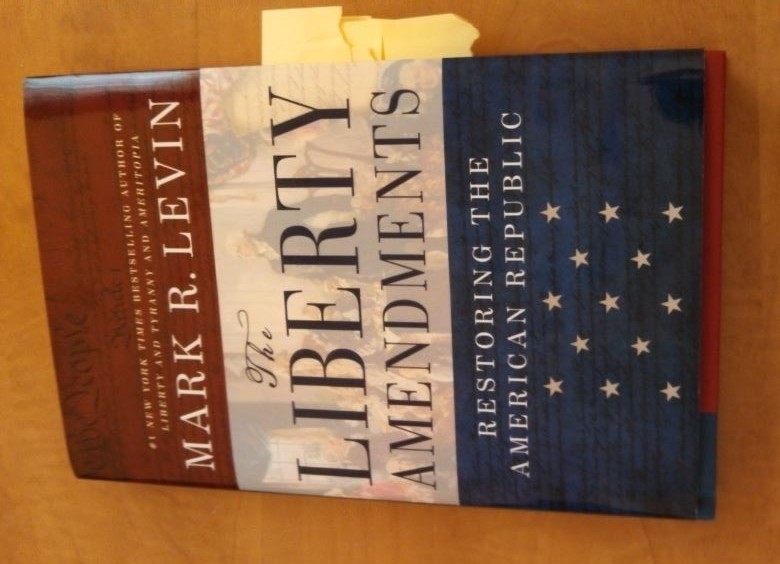
The Liberty Amendments


Mark Levin’s new book, The Liberty Amendments: Restoring The American Republic is out, and it proposes an ambitious set of Amendments to the Constitution:
"I undertook this project not because I believe the Constitution, as originally structured, is outdated and outmoded, thereby requiring modernization through amendments, but because of the opposite — that is, the necessity and urgency of restoring constitutional republicanism and preserving the civil society from the growing authoritarianism of a federal Leviathon. This is not doomsaying or fearmongering but an acknowledgment of facgt. The Statists have been successful in their century-long march to disfigure and mangle the constitutional order and undo the social compact."
So starts the book. Which then goes on to analyze where the country has gone wrong constitutionally and to propose the following constitutional remedies:
  • An Amendment to Establish Term Limits for Members of Congress
  • An Amendment to Restore the Senate
  • An Amendment to Establish Term Limits for Supreme Court Justices and Super-Majority Legislative Override
  • Two Amendments to Limit Federal Spending and Taxing
  • An Amendment to Limit the Federal Bureaucracy
  • An Amendment to Promote Free Enterprise
  • An Amendment to Protect Private Property
  • An Amendment to Grant the States the Authority to Directly Amend the Constitution
  • An Amendment to Grant the States the Authority to Check Congress
  • An Amendment to Protect the Vote
(Mark Levin's new book, The Liberty Amendments, with my yellow stickies.)
(Mark Levin’s new book, The Liberty Amendments, with my yellow stickies.)
I’m not going to go through each of these proposals. For that, buy the book (!) or if you want a synopsis, see Jeffrey Lord’s review at The American Spectator.  Joel Pollak also has a review at Breitbart.com as well as a detailed interview.
Rather, I’ll try to put it in context.  (I guess I gave it away in the post Title.)
As I was pondering how to write up this review, I saw a lot of Twitter chatter about an article by Stephen Moore at The Wall Street Journal, The Budget Sequester Is a Success:
The biggest underreported story out of Washington this year is that the federal budget is shrinking and much more than anyone in either party expected….
This reversal from the spending binge in 2009 and 2010 began with the debt-ceiling agreement between Mr. Obama and House Speaker John Boehner in 2011. The agreement set $2 trillion in tight caps on spending over a decade and created this year’s budget sequester, which will save more than $50 billion in fiscal 2013.
As long as Republicans don’t foolishly undo this amazing progress by agreeing to Mr. Obama’s demands for a “balanced approach” to the 2014 budget in exchange for calling off the sequester, additional expenditure cuts will continue automatically. Those cuts are built into the current budget law.
In other words, Mr. Obama has inadvertently chained himself to fiscal restraints that could flatten federal spending for the rest of his presidency.
The sense I get from reading the entirety of Levin’s Amendments is that they effectively are constitutional sequesters meant to restrain the runaway extra-constitutional expansion of the federal government without deferring to human nature.  Fundamentally, the proposed amendments are a firm check on the well-documented inclination of those with federal power to expand federal power.
The Constitution enumerates the powers of the federal government.  But, as Levin documents in his book, that enumeration has been largely eviscerated by politicians and judges who are beyond reach.  So Levin proposes constitutionally imposed term limits for Congress and the Supreme Court.  Politicians have a strong incentive to spend other people’s money to buy votes which corrupts the entire process, so Levin proposes Spending and Taxation limits.  The other amendments address similar problems.
As Levin states in his interview with Pollak linked above (emphasis mine):
And I’ve concluded that Washington is incapable of reforming itself, which should seem fairly obvious. After all, it has designed the federal Leviathan, which is getting bigger and more aggressive.  And I was thinking: What has this federal government become? It is not a constitutional, federal, or representative republic, as our Framers understood those institutions. I believe the federal government is increasingly operating outside the Constitution and that we are in a post-constitutional period. This is how justices, presidents, and members of Congress are able to concoct and then impose such monstrous laws as Obamacare and Dodd-Frank, among thousands of other laws and rules every year, on an unwitting population.
I’d have to think through the “what ifs” of some of these proposals, such as repealing the 17th Amendment.  Considering that the unions control the legislature in my formerly home State of Rhode Island and Providence Plantations, I’m not sure empowering the state legislature to appoint Senators is an improvement.
I view these proposals less as a set of likely constitutional amendments, given the difficulty of the process, and more as a set of principles by which we must insist our elected representatives live.
A good use for the book would be to bring it to Town Hall meetings this summer and get your Representative — Republican or Democrat — to commit to where he or she stands on these principles.
Just hold up the book as you start to ask your question, and watch the faces of the politicians grimace, because they know what’s coming.

 The Liberty Amendments consists of a well thought-out program of amendments (offered as a starting point for discussion and modification), combined with a political strategy that could (at least potentially) work: using a constitutional convention called by two-thirds of the states. As Article 5 of the Constitution reads:

The Congress, whenever two thirds of both Houses shall deem it necessary, shall propose Amendments to this Constitution, or, on the Application of the Legislatures of two thirds of the several States, shall call a Convention for proposing Amendments, which, in either Case, shall be valid to all Intents and Purposes, as Part of this Constitution, when ratified by the Legislatures of three fourths of the several States, or by Conventions in three fourths thereof, as the one or the other Mode of Ratification may be proposed by the Congress; Provided that no Amendment which may be made prior to the Year One thousand eight hundred and eight shall in any Manner affect the first and fourth Clauses in the Ninth Section of the first Article; and that no State, without its Consent, shall be deprived of its equal Suffrage in the Senate.

In Chapter One of the Book, "Restoring the American Republic (also the subtitle of the book itself), Mark lays out his case that judicial precedent and politics have in effect altered the Constitution the framers intended us to have, and restoring a constitutional republic as originally envisioned is going to require some extensive amending. Fortunately, Mark has posted this chapter online for all to read. I urge readers to click on the link and see the case that Mark makes.

The actual program of amendments, each analyzed in a separate chapter, should be read by all who see in this bold and visionary program a way to rescue our republic before it falls, as it surely will if present conditions continue to develop as they have been since the progressives first gained power. Sure, it is easy for me to point out how difficult it is to accomplish the passage of calls for a constitutional convention in 34 states. But take a look at a map of the red states, and then imagine the sort of grass roots movement Mark calls for, one energized and focused on local legislators. And keep in mind that state legislatures would gain enormous resources and power, should something like the program of amendments be ratified. Self-interest, properly checked and balanced, is the essence of our founders' wisdom, and legislative self-interest is a factor worth keeping in mind.

The chapter titles indicate in broad outline the nature of the constitutional program Mark has in mind:

An Amendment to Establish Term Limits for Members of Congress

An Amendment to Restore the Senate (repeal of the 17th Amendment establishing direct elections, provisions for replacement of senators before the end of their terms, and establishing the right of a state legislature to remove a senator upon a two-thirds vote).

An Amendment to Establish Term Limits for Supreme Court Justices and Super-Majority Legislative Override

Two Amendments to Limit Federal Spending and Taxation (limiting the federal government to outlays not exceeding 17.5% of GDP, and limiting total federal tax collections from any source to no more than 15% of a person's income). I must confess that I found reliance on specific numbers troubling here and in a few other amendments because there is so much room for manipulation in calculating GDP and income, or in determining the value of certain dollar amounts included in other amendments.  But Mark makes very clear his is not the last word on this or any other subject, but merely a proposal to get people thinking about an entire package that counteract the transformation of the federal government into a colossus never imagined by the founders.

An Amendment to Limit the Federal Bureaucracy (automatic sunset for all department and agencies if they are not legislatively reauthorized, mandatory congressional authorization of any regulation imposed by bureaucrats if the economic burden exceeds $100 million).

An Amendment to Promote Free Enterprise (redefining the Commerce Clause to a specific grant of power limited to preventing states from impeding commerce among the states, and preventing Congress from regulating commerce within a state).

An Amendment to Protect Private Property (curbing abuses under the Takings Clause).

An Amendment to Grant the States Authority to Directly Amend the Constitution (allowing two thirds of the states, voting for the exact same language, to amend the Constitution, and providing a six year time frame within which the passage must be secured).

An Amendment to Grant States Authority to Check Congress (three fifths of the state legislatures may overturn acts of Congress or larger impact executive orders, within 24 months, with no judicial review permitted).

An Amendment to Protect the Vote (requiring photo ID for voting in person or via mail ballot and prohibiting electronic voting).

My summaries of the gist of each amendment ignore finer points in the text of each, not to mention in the discussions Mark presents.

Conservatives badly need to come together on a vision for America that can be presented to the American people as a way out of our dysfunctions that multiply with each growth of federal power. If Mark Levin succeeds in kicking off a grassroots movement to restore the constitutional balance, he will have performed a historic public service.

Theodore Koehl siad in "The American Thinker":
Top conservative radio talk show host, attorney and constitutional scholar Mark Levin announced the pending release of his new book, "The Liberty Amendments, Restoring the American Republic," this past Wednesday, July 10, 2013, during his regular broadcast. The book due out on or about August 13th of this year is sure to be well received and thoughtful exegesis regarding our Constitution, and in keeping with his best selling, "Liberty and Tyranny," as well as the more recent, "Ameritopia."

Levin previewed an argument under Article Five of the United States Constitution which expresses how the Constitution can be changed through the amendment process by using the traditional passage of a proposed amendment by two-thirds of both the House of Representatives and the Senate; then on to the several states for ratification. Once three-fourths of the states have ratified the proposed amendment, the approved Amendment becomes part of our United States Constitution.

What Levin also said was that the States could also propose a convention to add a specific amendment or reject a current amendment by calling an Amendment Convention. This convention would have no bearing on the existing framework of the Constitution, but would only affect the addition or subtraction of an amendment at hand.

Levin reported that under Article V of the Constitution, two-thirds of the several states could form a convention on their own through actions initiated through their own state legislatures. Once an amendment is successfully proposed, it could be ratified by approval of three-fourths of the legislatures of the several states, and then imparted into the Constitution.

The Founders placed this alternative method of amending the Constitution as an end-around the possible tyranny of an all-powerful federal government. The Founders knew the federal leviathan could never be completely trusted with policing itself and therefore gave ultimate authority to the states to make changes when they deemed it necessary.

Mr. Levin is correct in his assessment of the rights of the several states and their people to control their government, at every level. This contributor suggested a similar course of action in an article published by American Thinker on July 7, 2013 titled, " How to Repeal the 16th and 17th Amendments," where the proposal was made that the several states could initiate repeal of amendments by their respective legislatures voting to de-ratify or otherwise invalidate those current amendments.

Again, when two-thirds of the several states have filed an instrument to invalidate either the 16th or 17th Amendments, another vote takes place in many or all the states to approve or disapprove the amendment. Once three-fourths of the several states have voted to approve the proposed change, notification is presented to the Archivist of the National Archives for inclusion into the Constitution.

While some have expressed concern that a full Constitutional Convention is needed to effect changes outside the traditional Congressional process, Levin demonstrates this theory is not necessary and may be done by state's initiatives through their various legislatures in keeping with the people's wishes. An Article Five Amendment Convention is possible and maybe needed if the federal system continues to act outside its limited and strictly enumerated authority.

This author submits that accepting differences in paperwork processing, the states de-ratifying of any existing amendments are tantamount to the same as an Article Five Amendment Convention.

Read more: http://www.americanthinker.com/blog/2013/07/radio_host_mark_levin_suggests_the_states_call_an_article_five_amendment_convention.html#ixzz2bsyn

Thursday, December 13, 2012

ObamaCare Is Dead In The Water


ObamaCare was a poorly conceived and is a constitutionally deficient statute. The Supreme Court's ruling upholding the law has simply made it worse. In the future, that decision is likely to be seen as a prime reason that the federal court judges should just judge and never legislate—even in the cause of rescuing an otherwise unconstitutional law from oblivion.
In the ObamaCare ruling, the Supreme Court correctly held that Congress could not impose the individual mandate as a constitutional regulation of interstate commerce and that Congress could not constitutionally use its spending power to coerce the states to expand Medicaid.
Rather than strike down the law, however, the court construed the insurance-purchase mandate and its penalty as a "tax" on the failure to have health insurance. The justices also interpreted the Medicaid-expansion requirements as optional—permitting states to opt out of these provisions while staying within the traditional Medicaid program. Given that interpretation, the court's majority upheld the statute as constitutional.
The court's determination to preserve ObamaCare through "interpretation" has exacerbated the law's original flaws to the point that it has become palpably unworkable. By transforming the penalties for failing to comply with the law's requirements into a "tax," the court has given the public a green light to ignore ObamaCare's requirements when it is economically beneficial. Law-abiding individuals, who might otherwise have complied with the law's expensive purchase mandate to avoid being subjected to financial penalties, can simply now choose to pay a tax and not sign up for coverage. There is certainly no stigma attached to simply paying a tax, and noncompliance with the law's other requirements—such as those imposed on employers—is arguably made more attractive on the same basis. This effect fundamentally undercuts Congress's original purpose, which was to expand health-care coverage to the greatest number of people, not to improve federal revenues.
Similarly, having reviewed the likely costs and benefits, states are now taking advantage of the court-granted flexibility. Seven states, including Texas, Mississippi and Georgia, have so far opted out of the Medicaid-expansion provisions, and eight (with more certain to come) are refusing to create the insurance exchanges, leaving this to a federal bureaucracy unequipped to handle these new administrative burdens. As a result, a growing number of low-income Americans will be unable to obtain the free or cost-effective insurance that Congress originally meant them to have, although they remain subject to the mandate-tax.
On December 7, New Jersey Governor Chris Christie vetoed legislation establishing a state-run health insurance exchange. This was just after he had visited President Obama at the White House to discuss Superstorm Sandy cleanup costs. Governor Christie said he blamed President Obama for failing to provide answers that he needed to make a fiscally sound decision on the best way to comply with the ObamaCare law.
States have until December 14th to decide whether to establish a state-based exchange. They have more time to decide whether to partner with the federal government or to let federal bureaucrats design and run the state exchange. ((Santi, Angela, Christie Vetoes ObamaCare, Washington Times, Dec. 7, 2012)
Policy problems aside, by transforming the mandate into a tax to avoid one set of constitutional problems (Congress having exceeded its constitutionally enumerated powers), the court has created another problem. If the mandate is an indirect tax, as the Supreme Court held, then the Constitution's "Uniformity Clause" (Article I, Section 8, Clause 1) requires the tax to "be uniform throughout the United States." The Framers adopted this provision so that a group of dominant states could not shift the federal tax burden to the others. It was yet another constitutional device that was simultaneously designed to protect federalism and safeguard individual liberty.
The Supreme Court has rarely considered the Uniformity Clause's reach, but it cannot be ignored. The court also refused to impose meaningful limits on Congress's power to regulate interstate commerce for decades after the 1930s, until justices began to re-establish the constitutional balance in the 1990s with decisions leading up to the ObamaCare ruling this summer. And although the court has upheld as "uniform" taxes that affect states differently in practice, precedent makes clear that a permissible tax must "operate with the same force and effect in every place where the subject of it is found," as held in the Head Money Cases (1884). The ObamaCare tax arguably does not meet this standard.
ObamaCare provides that low-income taxpayers, who are nevertheless above the federal poverty line, can discharge their mandate-tax obligation by enrolling in the new, expanded Medicaid program, which serves as the functional equivalent of a tax credit. But that program will not now exist in every state because, as a matter of federal law, states can opt out. The actual tax burden will not be geographically uniform as the court's precedents require.
Thus, having transformed the individual mandate into a tax, the court may face renewed challenges to ObamaCare on uniformity grounds. The justices will then confront a tough choice. Having earlier reinterpreted the mandate as a tax, they would be hard-pressed to approve the geographic disparity created when states opt out of the Medicaid expansion. But that possibility is inherent in a scheme that imposes a nominally uniform tax liability accompanied by the practical equivalent of a fully off-setting tax credit available only to those living in certain states. To uphold such a taxing scheme would eliminate any meaningful uniformity requirement—a result that the Constitution does not permit.
(The Opening For a Fresh ObamaCare Challenge, Rivkin, David B. and Casey, Lee A.p; WSJ, Dec. 6, 2012)

How the Supreme Court Doomed the Affordable Care Act to Failure

January 9, 2013
The Supreme Court's surprise ruling on the Affordable Care Act (ACA) has left many observers wondering about the implications of the ruling on the law itself, says Thomas A. Lambert, the Judge C.A. Leedy Professor of Law at the University of Missouri Law School.
  • In a 5-4 decision, the Supreme Court ruled that the ACA is constitutional.
  • In writing the opinion, Chief Justice Roberts, argued that the individual mandate is nothing more than a tax.
  • However, the Court struck down the provision that would deny Medicaid funding to states that did not expand their Medicaid roles.
Together, the ruling has a profound impact on the health care market and is likely to raise premiums and the cost of medical care. For example, the cost of paying the tax for not having insurance is not steep enough to encourage young, healthy individuals to enter the health care market. These individuals would rather take the risk and pay the penalty because it would be cheaper than acquiring health insurance.
This is problematic considering that the infusion of younger and healthier individuals is necessary to spread risk in the market and lower overall premiums. In addition, the decision also limits Congress's ability to increase the penalty.
Proponents of the ACA argue that the subsidies in the bill will entice younger people to purchase insurance. However, the subsidies are too small and out-of-pocket costs for insurance will be much higher than simply paying the tax.
Additionally, the efforts to reduce medical costs are likely to fall short of achieving their goals. The ACA has aimed at doing the following:
  • Increased funding for eliminating waste, fraud and abuse.
  • Price controls on Medicare charges.
  • Emphasis on preventative care.
There are other measures as well but none of them attack the root of health care inflation: the lack of competition in providing medical services. If consumers were put in a position to pay more for their health care, there would be more emphasis on finding an affordable insurance plan. As a result, insurance companies and other medical services would compete to lower their prices and attract new customers.
( Thomas A. Lambert, "How the Supreme Court Doomed the ACA to Failure,")

Monday, December 13, 2010

ObamaCare Ruled Unconstitutional By Virginia Federal Judge.

RICHMOND - A federal judge in Virginia ruled 13 December 2010 that a key provision of the nation's sweeping health-care overhaul is unconstitutional, the most significant legal setback so far for President Obama's signature domestic initiative.

U.S. District Court Judge Henry E. Hudson found that Congress could not order individuals to buy health insurance.

In a 42-page opinion, Hudson said the provision of the law that requires most individuals to get insurance or pay a fine by 2014 is an unprecedented expansion of federal power that cannot be supported by Congress's power to regulate interstate trade.

"Neither the Supreme Court nor any federal circuit court of appeals has extended Commerce Clause powers to compel an individual to involuntarily enter the stream of commerce by purchasing a commodity in the private market," he wrote. "In doing so, enactment of the [individual mandate] exceeds the Commerce Clause powers vested in Congress under Article I [of the Constitution.]

Hudson is the first judge to rule that the individual mandate is unconstitutional. He said, however, that portions of the law that do not rest on the requirement that individuals obtain insurance are legal and can proceed. Hudson indicated there was no need for him to enjoin the law and halt its implementation, since the mandate does not go into effect until 2014.

The ruling comes in a case filed by Virginia Attorney General Ken Cuccinelli II (R), who said he was defending a new state statute that made it illegal to require people to carry health insurance in Virginia.

"I am gratified we prevailed," Cuccinelli said in a statement. "This won't be the final round, as this will ultimately be decided by the Supreme Court, but today is a critical milestone in the protection of the Constitution."

Federal officials responded that they are confident the statute will ultimately be upheld. A victory for Cuccinelli at this early legal stage means no more for the law's fate than previous rulings that have found the opposite, they have argued.

"We are disappointed in today's ruling but continue to believe - as other federal courts in Virginia and Michigan have found - that the Affordable Care Act is constitutional," Tracy Schmaler, a spokeswoman for the U.S. Department of Justice, said in a statement. "There is clear and well-established legal precedent that Congress acted within its constitutional authority in passing this law, and we are confident that we will ultimately prevail."

At the White House, spokesman Robert Gibbs pointed to the other rulings in favor of the individual mandate. "We are confident that [the individual mandate] is constitutional, he said. "We disagree with the ruling."

According to a new Washington Post-ABC News poll, a slim majority of all Americans - including almost all Republicans - oppose the health-care reform law. But the legislation's detractors are split on whether and how much of it should be rolled back.

Overall, 52 percent of those polled oppose the overhaul to the health-care system; 43 percent are supportive of it. Fully 86 percent of Republicans are against the legislation; 67 percent of Democrats support it. Independents divide down the middle, with 47 percent in favor and the same number opposed.

Most of those who oppose the health-care changes - 59 percent - want the law repealed, but 38 percent would prefer a "wait and see" approach. Democrats who oppose the law generally support waiting to see how the law operates, while most Republicans would prefer to see it repealed.

Republicans, though, are divided about whether the pullback should be a total repeal or only a partial one. Among Republicans opposed to the health-care package, 39 percent want a complete repeal, and 32 percent want to cancel parts of the law.

In large part, the mixed approach to amending the legislation reflects high Republican support for components of the legislation.

The Virginia suit is one of 25 legal challenges to the federal law wending their way through the federal courts across the country. In two other lawsuits, judges sitting in Michigan and Lynchburg, Va., have found that the same provision of the law passed legal muster. A third judge in Florida is also weighing constitutionality of the individual mandate in a suit jointly filed by 20 states.

The statute's constitutionality will ultimately be determined by the U.S. Supreme Court.

The ruling by Hudson, an appointee of President George W. Bush's, was widely anticipated based on tough questions he lobbed at Obama administration lawyers in oral arguments in his Richmond courtroom.

But the legal defeat will deal a significant political blow to the law, cheering those who have predicted its demise will come from adverse legal rulings rather than congressional repeal.

The Virginia suit would ordinarily next be heard by the Fourth Circuit Court of Appeals. Cuccinelli has indicated, however, that he would like to bypass the appeals court and move directly to the Supreme Court, an extraordinary legal maneuver that would require the high court to decide that the case held extreme public importance and intervene immediately.

He has asked the White House to sign on to the request, arguing they, too, would benefit from a quick resolution to legal questions surrounding the law. However, it is not clear whether the White House will agree.

A senior administration official has called that route "very unusual," noting that another suit is already pending before the Fourth Circuit, but declined to take the issue entirely off the table.

Tuesday, March 30, 2010

Are We Facing A Constitutional Crisis, Socialism, or A Police State?

Many people believe that the Supreme Court will declare President Omama's Health Care Law unconstitutional. Former New Jersey Superior Court Judge, Andrew P. Napolitano, is one of the most vocal. According to Judge Napolitano "President Barack Obama is one of the worst presidents ever in terms of respecting constitutional limitations on government, and the states suing the federal government over healthcare reform "have a pretty strong case" and are likely to prevail."

Napolitano says the president's healthcare reforms amount to "commandeering" the state legislatures for federal purposes, which the Supreme Court has forbidden as unconstitutional.

"The Constitution does not authorize the Congress to regulate the state governments," Napolitano says. "Nevertheless, in this piece of legislation, the Congress has told the state governments that they must modify their regulation of certain areas of healthcare, they must surrender their regulation of other areas of healthcare, and they must spend state taxpayer-generated dollars in a way that the Congress wants it done. That's called commandeering the legislature," he says. "That's the Congress taking away the discretion of the legislature with respect to regulation, and spending taxpayer dollars. That's prohibited in a couple of Supreme Court cases. So on that argument, the attorneys general have a pretty strong case and I think they will prevail.”

The longstanding precedent of state regulation of the healthcare industry makes the new federal regulations that much more problematic.

"The Supreme Court has ruled that in areas of human behavior that are not delegated to the Congress in the Constitution, and that have been traditionally regulated by the states, the Congress can't simply move in there," Napolitano says. "And the states for 230 years have had near exclusive regulation over the delivery of healthcare. The states license hospitals. The states license medications. The states license healthcare providers whether they're doctors, nurses, or pharmacists. The feds have had nothing to do with it.

"The Congress can't simply wake up one day and decide that it wants to regulate this. I predict that the Supreme Court will invalidate major portions of what the president just signed into law…"

The judge also says he would rate President Obama as one of the worst presidents in terms of obedience to constitutional limitations.

"I believe we have a one party system in this country, called the big-government party," Napolitano says. "There is a Republican branch that likes war and deficits and assaulting civil liberties. There is a Democratic branch that likes welfare and taxes and assaulting commercial liberties.

"President Obama obviously is squarely within the Democratic branch. The president who had the least fidelity to the Constitution was Abraham Lincoln, who waged war on half the country, even though there's obviously no authority for that, a war that killed nearly 700,000 people. President Obama is close to that end of lacking fidelity to the Constitution. He wants to outdo his hero FDR."

That is the good news. The bad news is that many of the legal challenges to healthcare reform will have to wait until 2014, when the changes become fully operational.

Until then, there would be no legal case that individuals had been actually harmed by the law. Moreover, Napolitano says it takes an average of four years for a case to work its way through the various federal courts the final hearing that's expected to come before the Supreme Court.

"You're talking about 2018, which is eight years from now, before it is likely the Supreme Court will hear this," he says.

Other issues that Judge Napolitano waxes eloquently concerning are:

He believes American is in danger of becoming "a fascist country," which he defines as "private ownership, but government control." He adds, "The government doesn't have the money to own anything. But it has the force and the threat of violence to control just about anything it wants. That will rapidly expand under President Obama, unless and until the midterm elections give us a midterm correction – which everyone seems to think, and I'm in that group, is about to come our way.
Napolitano believes the federal government lacks the legal authority to order citizens to purchase healthcare insurance. The Congress [is] ordering human beings to purchase something that they might not want, might not need, might not be able to afford, and might not want -- that's never happened in our history before," Napolitano says. "My gut tells me that too is unconstitutional, because the Congress doesn't have that kind of power under the Constitution."
The sweetheart deals in the healthcare reform bill used that persuaded Democrats to vote for it – the Louisiana Purchase, Cornhusker Kickback, Gatorade Exception and others – create "a very unique and tricky constitutional problem" for Democrats, because they treat citizens differently based on which state they live in, running afoul of the Constitution's equal protection clause according to Napolitano. "So these bennies or bribes, whatever you want, or horse trading as it used to be called, clearly violate equal protection by forcing people in the other states to pay the bills of the states that don't have to pay what the rest of us do," Napolitano says.
Exempting union members from the so-called "Cadillac tax" on expensive health insurance policies, while imposing that tax on other citizens, is outright discrimination according to Napolitano. "The government cannot draw a bright line, with fidelity to the Constitution and the law, on the one side of which everybody pays, and the other side of which some people pay. It can't say, 'Here's a tax, but we're only going to apply it to nonunion people. Here's a tax, and we're only going to apply it to graduates of Ivy League institutions.' The Constitution does not permit that type of discrimination."
Politicians from both parties routinely disregard the Constitutional limits imposed on them by the nation's founding document, Napolitano says. "The problem with the Constitution is not any structural problem," says Napolitano. "The problem with the constitution is that those who take an oath to uphold it don't take their oath seriously. For example, just a month ago in interviewing Congressman Jim Clyburn, who's the No. 3 ranking Democrat in the House, I said to him, Congressman Clyburn, can you tell me where in the Constitution the Congress is authorized to regulate healthcare? He said, 'Judge, most of what we do down here,' referring to Washington, 'is not authorized by the Constitution. Can you tell me where in the Constitution we're prohibited from regulating healthcare.' Napolitano says that reflects a misunderstanding of what the Constitution actually is. "He's turning the Constitution on its head, because Congress is not a general legislature," he says. "It was not created in order to right every wrong. It exists only to legislate in the 17 specific, discrete, unique areas where the Constitution has given it power. All other areas of human area are reserved for the states."
Napolitano says that members of Congress infringe on Constitutional rights because they fail to recognize its basis. "They reject Jefferson's argument, in the Declaration of Independence, that our rights come from our Creator, therefore they're natural rights, therefore they can't be legislated away," Napolitano says. "They think they can legislate on any activity, regulate any behavior, tax any person or thing, as long as the politics will let them survive. They're wrong, and with this healthcare legislation, they may be proven wrong, in a very direct and in-your-face way."

10 Ways the New Healthcare Bill May Affect You

The Patient Protection and Affordable Healthcare Act, more commonly referred to as the "healthcare bill", has taken over a year to craft and has been a lightning rod for political debate because it effectively reshapes major facets of the country's healthcare industry.
Here are 10 things you need to know about how the new law may affect you:

1. Your Kids are Covered
Starting this year, if you have an adult child who cannot get health insurance from his or her employer and is to some degree dependent on you financially, your child can stay on your insurance policy until he or she is 26 years old. Currently, many insurance companies do not allow adult children to remain on their parents' plan once they reach 19 or leave school.
2. You Can't be Dropped
Starting this fall, your health insurance company will no longer be allowed to "drop" you (cancel your policy) if you get sick. In 2009, "rescission" was revealed to be a relatively common cost-cutting practice by several insurance companies. The practice proved to be common enough to spur several lawsuits; for example, in 2008 and 2009, California's largest insurers were made to pay out more than $19 million in fines for dropping policyholders who fell ill.

3.Children cannot be denied coverage.
Starting this year your child (or children) cannot be denied coverage simply because they have a pre-existing health condition. Health insurance companies will also be barred from denying adults applying for coverage if they have a pre-existing condition, but not until 2014.
4. You Can Spend What You Need to
Prior to the new law, health insurance companies set a maximum limit on the monetary amount of benefits that a policyholder could receive. This meant that those who developed expensive or long-lasting medical conditions could run out of coverage. Starting this year, companies will be barred from instituting caps on coverage.
5. You Don't Have to Wait
If you currently have pre-existing conditions that have prevented you from being able to qualify for health insurance for at least six months you will have coverage options before 2014. Starting this fall, you will be able to purchase insurance through a state-run "high-risk pool", which will cap your personal out-of-pocket expenses for healthcare. You will not be required to pay more than $5,950 of your own money for medical expenses; families will not have to pay any more than $11,900.
6. You Must be Insured
Under the new law starting in 2014, you will have to purchase health insurance or risk being fined. If your employer does not offer health insurance as a benefit or if you do not earn enough money to purchase a plan, you may get assistance from the government. The fines for not purchasing insurance will be levied according to a sliding scale based on income. Starting in 2014, the lowest fine would be $95 or 1% of a person's income (whichever is greater) and then increase to a high of $695 or 2.5% of an individual's taxable income by 2016. There will be a maximum cap on fines.
7. You'll Have More Options
Starting in 2014 (when you will be required by law to have health insurance), states will operate new insurance marketplaces - called "exchanges" - that will provide you with more options for buying an individual policy if you can't get, or afford, insurance from your workplace and you earn too much income to qualify for Medicaid. In addition, millions of low- and middle-income families (earning up to $88,200 annually) will be able to qualify for financial assistance from the federal government to purchase insurance through their state exchange.
8. Flexible Spending Accounts Will Become Less Flexible
Three years from now, flexible spending accounts (FSAs) will have lower contribution limits - meaning you won't be able to have as much money deducted from your paycheck pre-tax and deposited into an FSA for medical expenses as is currently allowed. The new maximum amount allowed will be $2,500. In addition, fewer expenses will qualify for FSA spending. For example, you will no longer be able to use your FSA to help defray the cost of over-the-counter drugs.
9. If You Earn More, You'll Pay More
Starting in 2018, if your combined family income exceeds $250,000 you are going to be taking less money home each pay period. That's because you will have more money deducted from your paycheck to go toward increased Medicare payroll taxes. In addition to higher payroll taxes you will also have to pay 3.8% tax on any unearned income, which is currently tax-exempt.
10. Medicare May Cover More or Less of Your Expenses
Starting this year, if Medicare is your primary form of health insurance you will no longer have to pay for preventive care such as an annual physical, screenings for treatable conditions or routine laboratory work. In addition, you will get a $250 check from the federal government to help pay for prescription drugs currently not covered as a result of the Medicare Part D "doughnut hole".
However, if you are a high-income individual or couple (making more than $85,000 individually or $170,000 jointly), your prescription drug subsidy will be reduced. In addition, if you are one of the more than 10 million people currently enrolled in a Medicare Advantage plan you may be facing higher premiums because your insurance company's subsidy from the federal government is going to be dramatically reduced.
Conclusion
Over the next few months you will most likely receive information in the mail from your health insurance company about how the newly signed law will affect your coverage. Read the correspondence carefully and don't hesitate to ask questions about your policy; there may be new, more affordable options for you down the road.
(March 29, 2010 K. Rowland said:)
The same Supreme Court justices whom President Obama blasted during his State of the Union address this year may ultimately decide the fate of his crowning achievement as more than a dozen states have called on the courts to strike down the health insurance mandate of Democrats' health care overhaul - a move that would threaten the entire law.

Two major constitutional challenges have been levied against the new law, one by the state of Virginia, which enacted a law exempting its citizens from the federal health insurance mandate, and another by Florida and 12 other states. Legal scholars are divided on the merits of the cases, and even Congress - through its research service and its budget scorekeeper - has said it's an open question whether the provision could pass constitutional muster.

At issue is the scope of the federal government's power over states and individuals. Critics of the law say the requirement that all Americans buy insurance or pay a fine, if allowed, would mean that Congress has virtually boundless authority to compel actions. Proponents argue that legal precedents support an expansive reading of the legislative branch's license to regulate such activity.

"This is one of the most consequential lawsuits in our generation," said Baker Hostetler lawyer David B. Rivkin Jr., who is serving as outside counsel to the 13 states that have filed suit. "The fact you have so many different state attorneys general, Republicans and Democrats, from a variety of states coming together to do this just underscores how strongly they feel that the act infringes core constitutional interests of their respective states."

The mandate, which doesn't take effect until 2014, is central to Democrats' goal of insuring about 32 million more Americans. The law would offer tax credits to low-income individuals and allow young adults to remain on their parents' policies longer.

Both of the state lawsuits challenge the federal government's authority under the Commerce Clause, which grants Congress the power to regulate commerce among the states. The Florida case also cites a violation of the 10th Amendment, which reserves those powers not spelled out under the federal government in the Constitution to the state governments, and argues that the health care law's expansion of state Medicaid programs threatens state sovereignty.

Among the arguments against the law is that because it does not allow for purchasing insurance across state lines - the insurance exchanges are state-based - the buying of health insurance does not constitute interstate commerce. In addition, the plaintiffs say, not purchasing health insurance does not constitute an economic activity.

"Thus far in our history, it has never been held that the Commerce Clause, even when aided by the Necessary and Proper Clause, can be used to require citizens to buy goods or services," Virginia Attorney General Kenneth T. Cuccinelli II argues in his state's lawsuit. "To depart from that history to permit the national government to require the purchase of goods or services would ... create powers indistinguishable from a general police power in total derogation of our constitutional scheme of enumerated powers."

While a requirement to buy health insurance might be new, some legal analysts say, Congress can in fact define an economic activity as something that results from not taking an action.

"The 1964 Civil Rights Act prohibits hotels and restaurants from discriminating based on race and thus prohibits inactivity," said Erwin Chemerinsky, dean of the University of California Irvine School of Law, noting that law relied upon the Commerce Clause. "The Supreme Court has said that Congress can regulate economic activity that has a substantial effect on interstate commerce. Buying or refusing to buy insurance is economic activity. The effect on the economy is enormous."

As an example, Mr. Chemerinsky cited cases in which the high court upheld Congress' authority to regulate the amount of wheat that farmers grow for their own home consumption or prohibit the cultivation of marijuana for medicinal purposes.

"If that fits within the commerce power, surely the health industry does," he said.

Mr. Rivkin, who served in various legal capacities for the Reagan administration and the George H.W. Bush administration, strongly disagreed. If that were the case, he argued, there would be no limits to the government's power as the Founding Fathers intended. He said the cases cited by Mr. Chemerinsky involve the cultivating of commodities and therefore clearly economic activities, unlike the refusal to purchase health insurance.

"The remarkable thing about an individual insurance purchase mandate is you are not being subject to a requirement by virtue of any economic activity you engage in - you're not doing a damn thing; you just exist," he said. "If this is upheld, then the federal government can do everything it wants subject only to the restrictions contained in the Bill of Rights."

Democratic leaders and the White House have scoffed at the legal challenges. Last week, press secretary Robert Gibbs said administration attorneys advised him "we'll win these lawsuits."

Jack M. Balkin, a professor at Yale Law School, noted that the new law structures the mandate as an amendment to the tax code and includes a discussion of the impact on state commerce, suggesting that the administration will defend it by citing the Commerce Clause as well as Congress' power to tax under the "general welfare" provision. That provision says the federal government may impose taxes - in this case, the penalty for those who don't buy insurance would be the tax - in order to provide for the "general welfare" of the country.

Not everyone agrees with that reasoning.

"It is a taxation and spending power, not an open-ended general welfare clause," said Michael W. McConnell, a Stanford law professor and former circuit court judge appointed by President George W. Bush. "And by the way, 'general' had a very specific meaning in the late 18th century - it meant nationwide in scope, which is why some of the state-specific provisions are constitutionally dubious."

Both lawsuits are in federal district courts, but analysts expect the issue to end up before the Supreme Court. If the high court were to rule in favor of the plaintiffs, the ramifications for Congress could be sweeping.

"It would be difficult for the court to hold that the law is outside of the power to tax and spend for the general welfare without calling into question various regulatory devices that both parties use in crafting legislation," Mr. Balkin said. "Since the New Deal, both parties have used the taxing and spending power for a wide range of regulatory purposes and this is what the challenge to the health care bill calls into question."

However, the justices have not been averse to striking down congressional laws favored by Mr. Obama. The president used his State of the Union address to attack, with the justices present, a decision that struck down limits on corporate and union spending for political campaigns on First Amendment grounds.

In his speech, Mr. Obama warned of foreign influence over U.S. elections while Justice Samuel A. Alito Jr. silently mouthed that Mr. Obama was not telling the truth. Chief Justice John G. Roberts Jr., in response to a questioner at a speech some weeks later, called the president's words "very troubling."